The voluntourism problem
7 May 2026 · 7 min read
A two-week volunteer placement in a developing country typically costs between $2,500 and $3,500. That covers flights, accommodation, programme fees, and the warm feeling of having done something. The local teacher whose job you're briefly and badly doing earns about $2,400-3,600 per year. You could fund their entire salary for what you spent on the trip. You'd have done more good staying home and writing a cheque.
This is the voluntourism problem. Not that the volunteers are bad people, but that the economics are upside down and almost nobody mentions it.
The numbers are grim
The volunteer tourism industry generates an estimated $2-3 billion annually. About 1.6 million people participate each year, mostly from the US, UK, Australia, and Canada. The average participant is 18-25, female, university-educated, and motivated by a genuine desire to help combined with an equally genuine desire to have an interesting experience abroad.
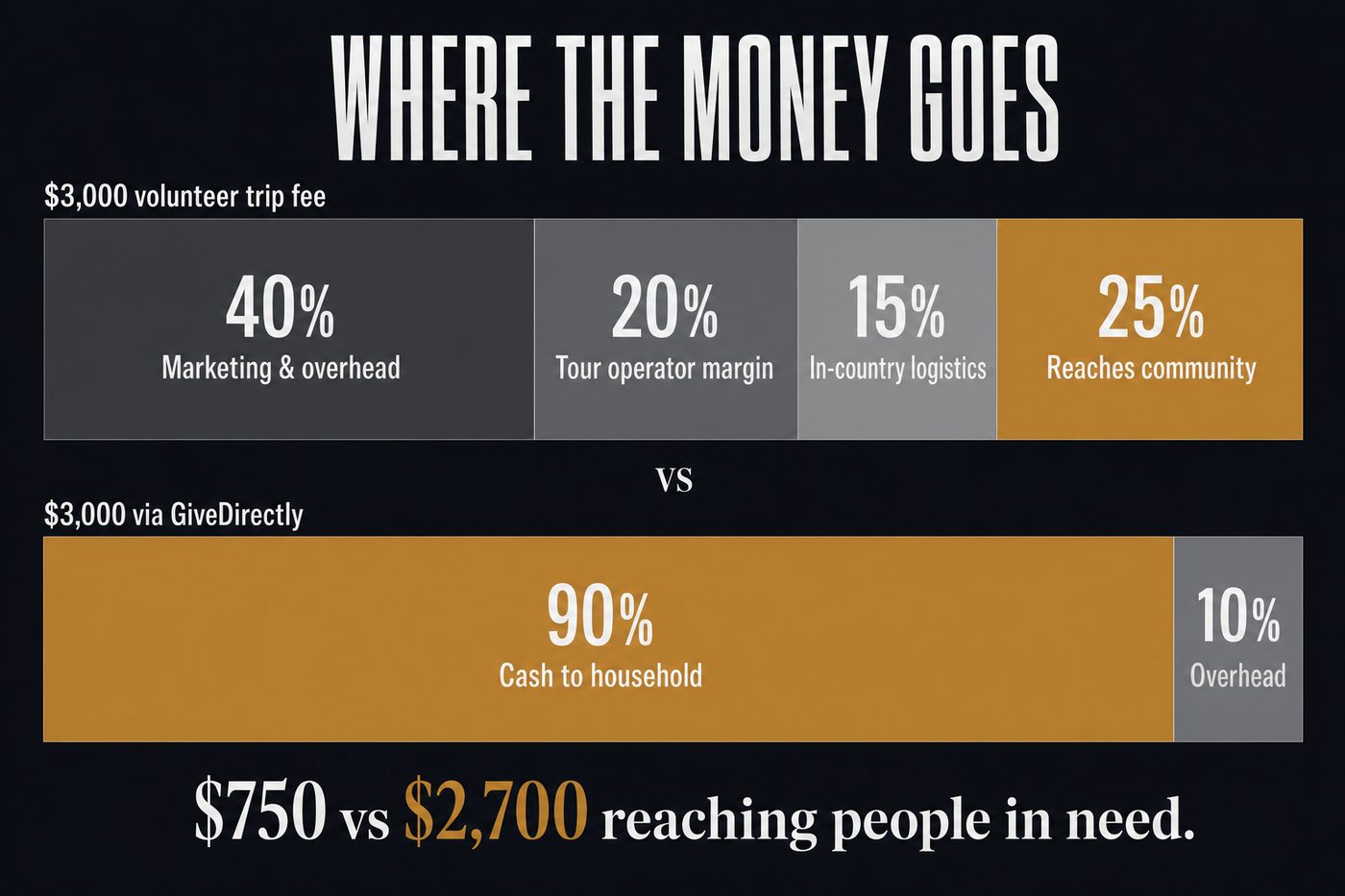
The trouble is that most of the money stays in the sending country. A 2019 analysis by the Overseas Development Institute found that for many volunteer tourism packages, less than 25% of the fee reaches the host community. The rest covers marketing, overhead, insurance, in-country logistics run by international staff, and the tour operator's margin.
So from a $3,000 trip, roughly $750 reaches the community. That same $3,000 donated directly to GiveDirectly would transfer about $2,700 in cash to an extremely poor household, with their overhead running at around 10%.
The orphanage problem specifically
This is where the evidence turns from "wasteful" to "actively harmful."
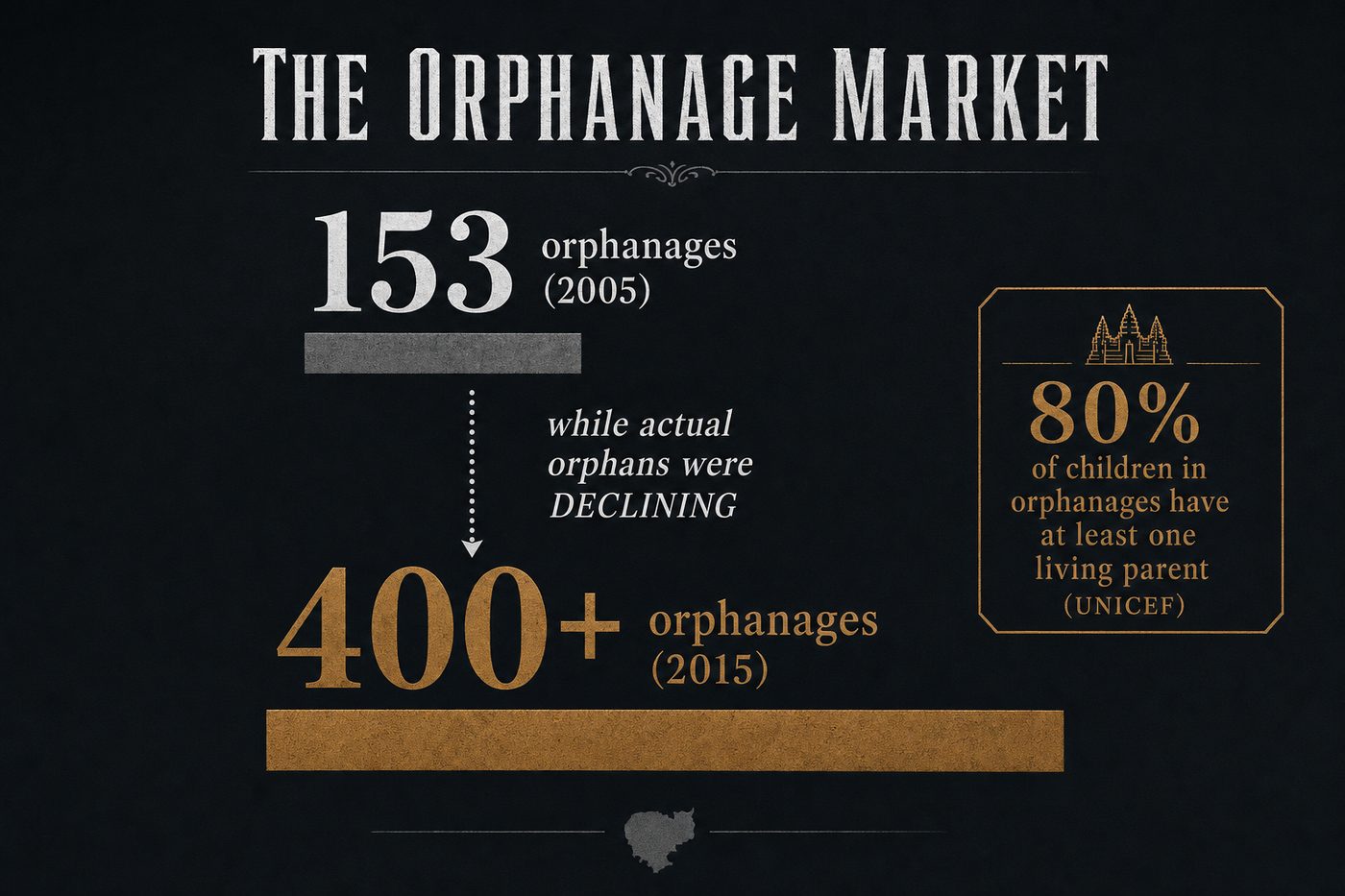
UNICEF estimates that 80% of children in orphanages in developing countries have at least one living parent. They're not orphans. They're children from poor families who were placed in institutions because the institution provides food and education that the family cannot afford. In some countries, particularly Cambodia and parts of sub-Saharan Africa, orphanages have proliferated specifically to meet the demand from volunteer tourists who want to interact with vulnerable children.
Lumos, the charity founded by J.K. Rowling to end institutional care of children, documented the mechanism clearly. More volunteer demand creates more orphanages. More orphanages creates incentives to recruit children from families. Children in institutional care have worse outcomes across every measured dimension: educational attainment, mental health, social development, future earnings. The volunteers create the market. The market creates the harm.
Cambodia went from 153 orphanages in 2005 to over 400 by 2015, while the number of actual orphans in the country was declining. Australia banned funding of orphanage tourism in 2018. The UK's Modern Slavery Act has been invoked in cases where children were trafficked into orphanages to meet tourist demand.
ReThink Orphanages, a coalition of over 100 organisations, now actively campaigns against orphanage volunteering and has published cost-effectiveness estimates suggesting that family-based care costs one-third to one-tenth as much as institutional care per child, with better outcomes on every metric.
The skills mismatch
Do Gooder
One good decision a week
The research behind each piece takes hours. Get the next evidence-backed read every Tuesday, in 3 minutes.
Free weekly read. Unsubscribe anytime, no guilt.
Even where the context isn't as toxic as orphanage tourism, the basic skills economics rarely work.
Sending an unqualified 20-year-old to build a school in Guatemala for two weeks costs more than hiring local labourers who build better, faster, and whose wages circulate in the local economy. The construction charity Habitat for Humanity has been candid about this: their "Global Village" volunteer trips exist primarily as a fundraising and awareness mechanism, not because foreign volunteers are the most efficient way to build houses.
Medical volunteer trips face the same problem. A 2017 systematic review in BMJ Global Health found that short-term medical missions frequently provide care that doesn't match local health priorities, fail to ensure follow-up, and sometimes cause harm through procedures performed by providers unfamiliar with local disease patterns and resource constraints.
The one exception, and it is a real exception, is highly skilled technical volunteers on longer placements. Engineers Without Borders, Médecins Sans Frontières, and similar organisations place people with specific expertise for months or years, not weeks. The selection is rigorous, the placements address genuine capacity gaps, and the organisations have systems for ensuring the work continues after the volunteer leaves.
Why it persists
Voluntourism persists because it serves the volunteer's needs better than the community's needs, and the volunteer is the one paying.
Gap year companies and university programmes market the experience as personal development with a side of altruism. The personal development part is probably real. Research on the volunteers themselves shows that many report increased empathy, cross-cultural competence, and a stronger sense of global citizenship after their trips. The question is whether those personal benefits justify the cost structure and, in the worst cases, the direct harm.
There's also an identity component. Coming back with stories of building a school or playing with children at an orphanage gives you a narrative that "I donated $3,000 to a cash transfer programme" doesn't. The experience is the product. The impact is secondary.
What to do instead
If you have $3,000 and want it to help people in developing countries, the blunt answer is: donate it. GiveDirectly, GiveWell's top charities, or any of the organisations rated by a credible evaluator will turn that money into measurable outcomes. $3,000 to Against Malaria Foundation buys enough bednets to protect roughly 500 people for three years.
If you want the experience of working in development, and that's a legitimate want, look for placements that are longer than a month, require specific skills, and are run by organisations that would exist whether or not volunteers showed up. VSO, Peace Corps, and MSF all place skilled volunteers on terms that actually serve the host community.
If you want a meaningful travel experience, just travel. Visit the country, spend money locally, learn something. You don't need to pretend it's charity. The pretence is where the damage lives.
Sources used
- Overseas Development Institute analysis of volunteer tourism value chains (2019)
- UNICEF data on children in institutional care ("80% have at least one living parent")
- Lumos "Orphanage Trafficking" report series
- Richter, L. M. & Norman, A. (2010) "AIDS orphan tourism: a threat to young children in residential care" Vulnerable Children and Youth Studies
- BMJ Global Health systematic review of short-term medical missions (2017)
- ReThink Orphanages cost-effectiveness estimates (family-based vs institutional care)
- Habitat for Humanity Global Village programme documentation
- Wearing, S. (2001) "Volunteer Tourism: Experiences That Make a Difference" (foundational academic text)
- GiveDirectly overhead and transfer efficiency data (2024)
- Cambodia orphanage proliferation data: Cambodian Ministry of Social Affairs, cited by Lumos
More in The Receipts