The policy donation
7 May 2026 · 7 min read
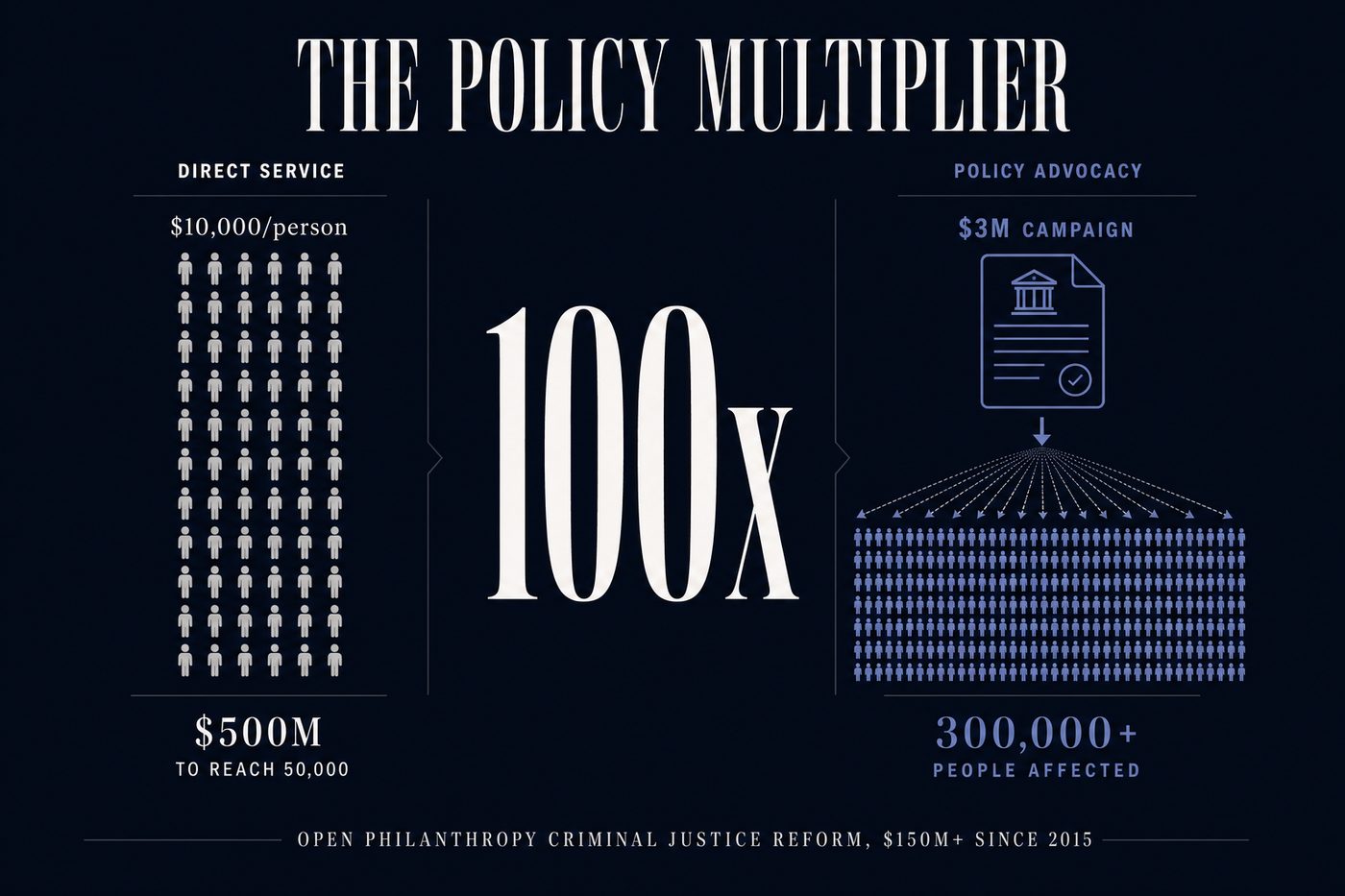
In 2015, Open Philanthropy made a grant to the Alliance for Safety and Justice, a criminal justice reform organisation. That grant, combined with others, contributed to the passage of Proposition 47 in California, which reclassified certain nonviolent felonies as misdemeanours. The policy change affected hundreds of thousands of people. The grant was in the low millions.
Compare that to funding a reentry programme for individual ex-prisoners, which might cost $5,000-10,000 per person served. To reach the same number of people directly would have cost billions.
This is the basic argument for policy advocacy as a charitable cause: when it works, it changes the rules for everyone at once, rather than helping people one at a time within the existing rules. When it works is the important caveat, and we'll get to that.
The multiplier effect
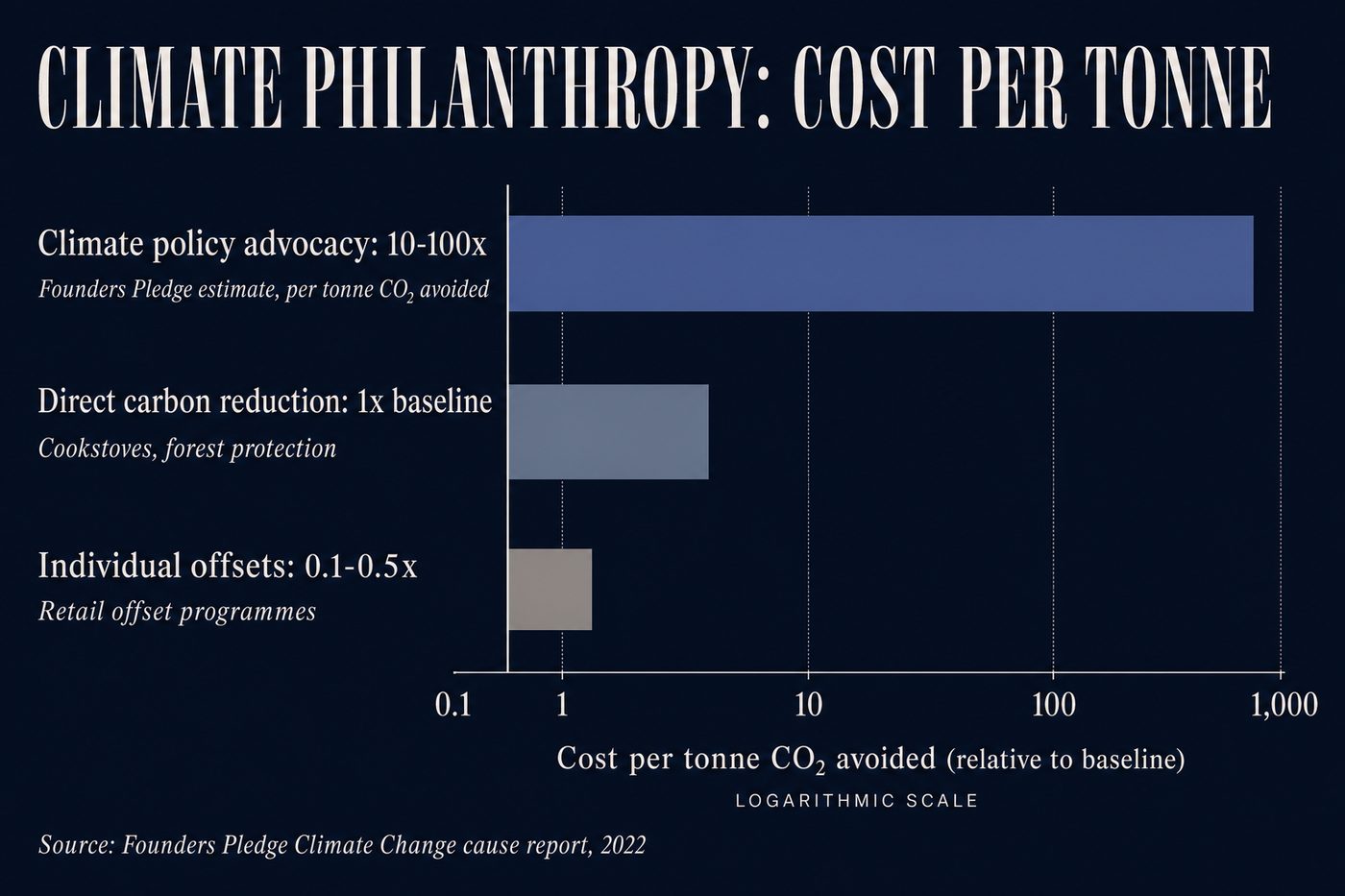
Founders Pledge published a detailed analysis of climate philanthropy in 2022 that tried to quantify this gap. Their finding: funding policy advocacy to reduce carbon emissions is somewhere between 10 and 100 times more cost-effective per tonne of CO2 avoided than funding direct carbon reduction programmes like cookstove distribution or forest protection.
The logic is straightforward, if uncomfortable. A successful campaign to strengthen emissions standards in one country's industrial sector can cut millions of tonnes of annual emissions. The campaign might cost $2-5 million. A direct intervention that reduces the same tonnage would cost orders of magnitude more, because you'd be buying the reduction one project at a time.
Open Philanthropy has committed over $150 million to criminal justice reform since 2015. They've also funded farm animal welfare policy (cage-free laws), immigration reform advocacy, and pandemic preparedness policy. Their internal analysis consistently finds that policy change, when it succeeds, beats direct service delivery on cost-effectiveness by wide margins.
Why most donors don't do this
There's a reason most charitable giving goes to direct service and not policy change, and it isn't stupidity but a combination of three factors that are all individually reasonable.
First, policy outcomes are uncertain. You can fund a campaign to change a law and the law doesn't change. You can fund a successful campaign and the law gets weakened in implementation, or repealed by the next government. The variance is enormous. A donation to Against Malaria Foundation buys a known number of bednets. A donation to a policy advocacy organisation buys an uncertain probability of a large but hard-to-measure outcome.
Second, policy work looks political, and many donors, particularly in the UK where charitable status is tied to non-partisan activity, are uncomfortable with anything that smells like politics. The Charity Commission strictly limits the political activities of registered charities. Donors who give through Gift Aid-eligible charities are constrained by this, even when the most effective use of their money would be advocacy.
Third, attribution is genuinely difficult. When a law changes, dozens of organisations, journalists, politicians, and public opinion shifts all contributed. It's hard to say that your £500 donation caused any specific fraction of the outcome. The effective altruism community has spent years developing counterfactual impact frameworks to handle this, but they're inherently less precise than "we distributed X nets and Y children didn't get malaria."
The Chetty problem
Do Gooder
One good decision a week
The research behind each piece takes hours. Get the next evidence-backed read every Tuesday, in 3 minutes.
Free weekly read. Unsubscribe anytime, no guilt.
Raj Chetty's research at Harvard on economic mobility in the US offers an interesting angle on this. His large-scale data analysis (published across multiple papers, most recently updated in 2024) shows that the neighbourhood you grow up in, the schools available, the local tax base, the zoning laws, all of these structural factors predict economic outcomes far more powerfully than any individual-level intervention.
The implication for donors: if you care about poverty reduction, and the structural determinants of poverty are more powerful than individual-level programmes, then funding structural change (policy, institutional reform, legal challenges) should in theory be more effective than funding direct services. The theory checks out. The practice is harder because structural change is slower, less certain, and harder to claim credit for.
The UK's Good Law Project offers a specific example. Their crowdfunded legal challenges have targeted government procurement practices, immigration policy, and NHS contracting. A successful judicial review can change policy for millions of people. The cost is typically £100,000-500,000 in legal fees. The per-person impact, when it works, is staggeringly cheap. When it fails, the money is gone.
Where policy donations make sense
Not everywhere. The argument for policy advocacy is strongest when three conditions hold.
The issue has a specific, achievable policy target. "End poverty" is not a policy target. "Pass a law requiring cage-free egg production by 2030" is. The cage-free campaign model (covered elsewhere on this site) is the clearest example of this working at scale.
There's a credible organisation with a track record of winning. Funding a new advocacy group with untested methods and unproven political connections is closer to venture philanthropy than evidence-based giving. Funding The Humane League's corporate campaigns, which have a documented 92% fulfilment rate on corporate commitments, is a different proposition.
The counterfactual matters. If the policy would have changed anyway without your donation, you haven't achieved anything. The most cost-effective policy donations go to campaigns that are genuinely marginal: close enough to winning that additional funding might tip the balance, but not so inevitable that the money was unnecessary.
What to actually do
If you're already giving to GiveWell-recommended charities and want to diversify into policy advocacy, Founders Pledge's recommended policy organisations are a reasonable starting point. Their climate recommendations include Clean Air Task Force and Carbon180. For animal welfare, The Humane League's Open Wing Alliance runs the kind of targeted corporate campaign that has the clearest evidence base in policy advocacy.
If you're in the UK, consider that some of the most effective giving opportunities may be non-charitable (in the legal sense) because they involve advocacy that exceeds Charity Commission limits. This means no Gift Aid, which raises the effective cost by 25%. Sometimes it's still worth it.
The uncomfortable truth about policy donations is that they require accepting more uncertainty in exchange for potentially larger impact. Not everyone finds that trade-off appealing, and that's a legitimate preference, not a mistake.
Sources used
- Founders Pledge "Climate Change" cause report (2022, updated 2024)
- Open Philanthropy criminal justice reform grant portfolio (public database, $150M+ since 2015)
- Chetty, R. et al. "The Opportunity Atlas" and subsequent papers on neighbourhood effects (2018-2024)
- Good Law Project case history and crowdfunding data
- The Humane League / Open Wing Alliance corporate commitment fulfilment data (92%, 2025)
- UK Charity Commission guidance on political activity by charities
- Centre for Effective Altruism policy research overview
More in Big Levers