The lead paint elimination
7 May 2026 · 7 min read
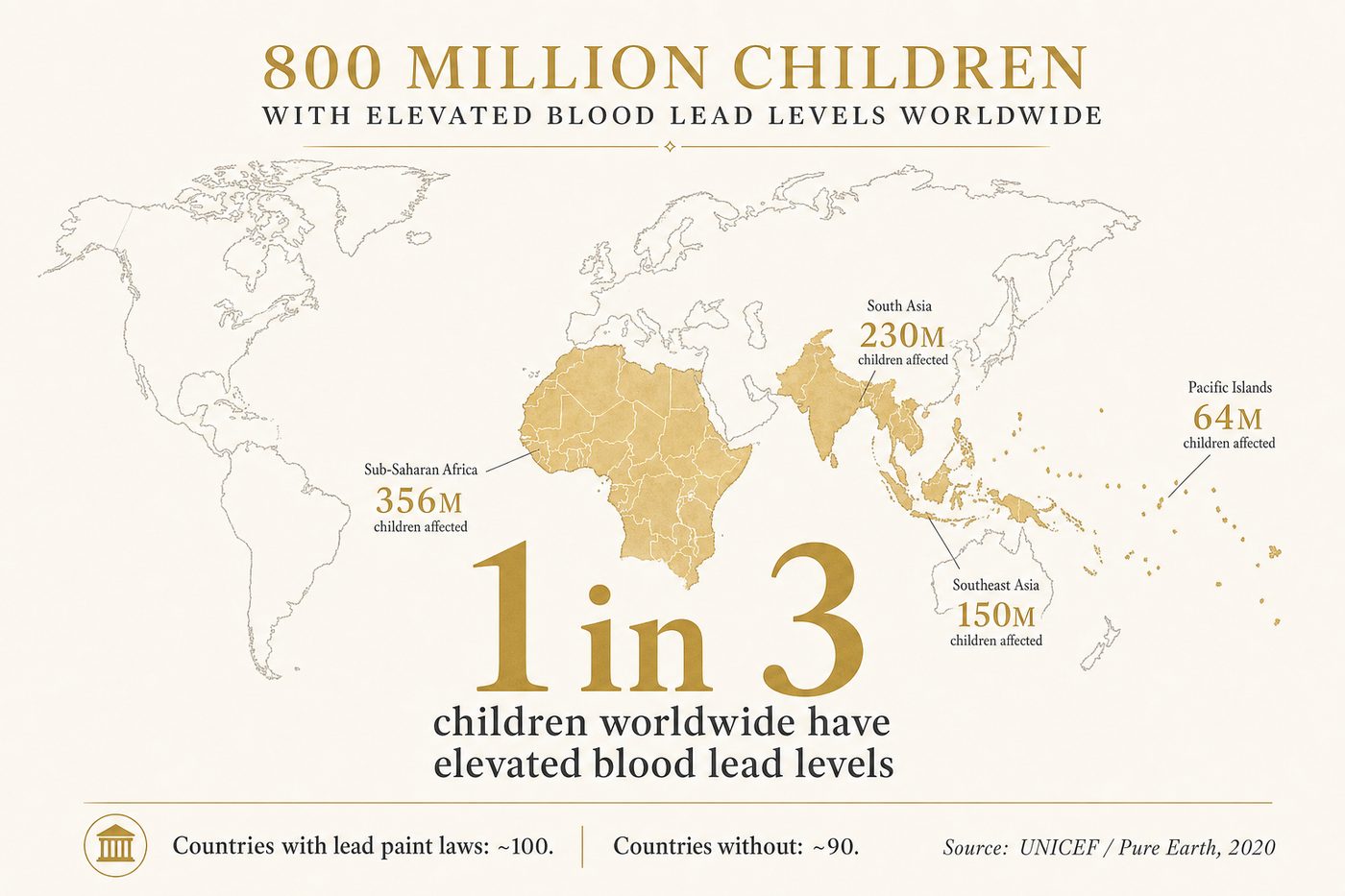
About 800 million children worldwide have blood lead levels above 5 micrograms per decilitre, the threshold at which health effects become measurable. That's roughly one in three children on the planet, according to a 2020 joint report by UNICEF and Pure Earth. The effects are permanent: for every 10 ug/dL increase in blood lead, IQ drops by 3-5 points. There is no known safe level of lead exposure in children.
Most people in wealthy countries think lead poisoning was solved in the 1970s, when leaded petrol was phased out and lead paint was banned in homes. Both of those things happened, and both mattered enormously. What didn't happen was a global ban on lead paint. As of 2024, roughly 55% of countries still lack legally binding controls on lead in paint.
This is one of the most cost-effective public health interventions that almost nobody is funding.
What lead paint regulation actually costs
The economics here are almost too good to be true, which is partly why they're under-studied. Rethink Priorities, in their cause area assessment, rated lead elimination as "very promising" on all three dimensions of their framework: scale (800 million children affected), neglectedness (tiny funding base relative to burden), and tractability (we know exactly what the intervention is, and it's cheap).
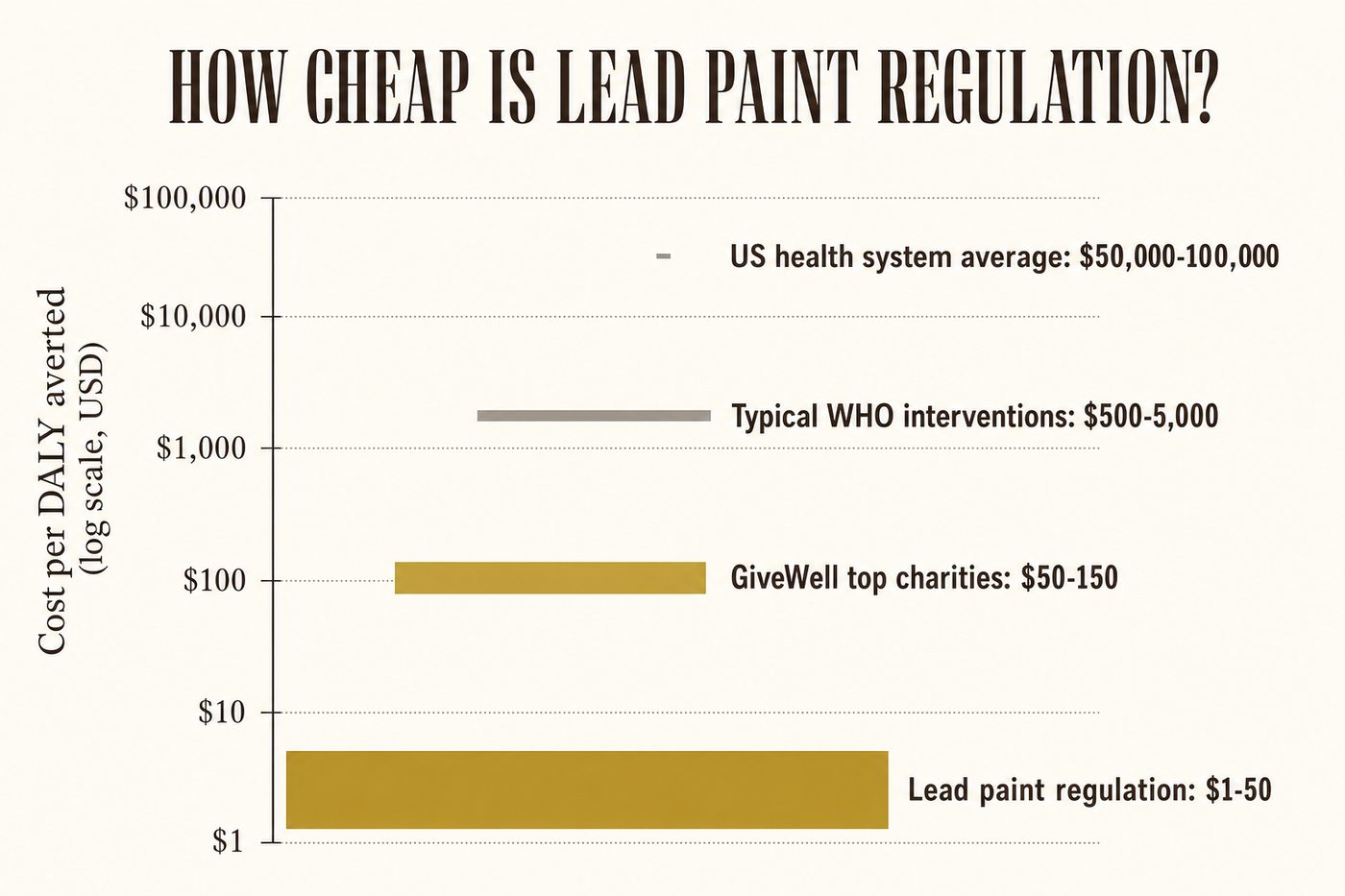
Cost-effectiveness estimates for lead paint regulation range from $1 to $50 per disability-adjusted life year (DALY) averted. That range depends on the country context and the specific regulatory pathway, but even the high end is extraordinarily cheap. For comparison, GiveWell's top charities typically operate at $50-150 per DALY averted, and those are already considered among the most cost-effective health interventions known.
The reason is that regulation is a policy lever, not a direct service. You don't treat 800 million children one at a time. You pass a law that prevents the paint from being manufactured, and the exposure stops at the source. The cost is the advocacy and regulatory support needed to get the law passed and enforced. In most low and middle-income countries, that's relatively cheap because the paint industry is small and the public health case is overwhelming.
LEEP and the GiveWell incubation model
The Lead Exposure Elimination Project, known as LEEP, was incubated by Charity Entrepreneurship in 2020 and received GiveWell incubation grants shortly after. They work in Malawi, Bangladesh, and other countries where lead paint regulation doesn't exist, helping governments draft and implement bans.
Their model is straightforward. They identify countries where lead paint is still widely used, where the regulatory gap exists, and where political conditions make a ban feasible. They provide technical support to government agencies drafting the regulations, fund laboratory testing of paint products on the market (to document the problem with hard numbers), and support enforcement after the law passes.
Malawi passed its lead paint regulations in 2022. LEEP supported the process from initial testing through to final legislation. The cost was a fraction of what it would take to treat the children already exposed, let alone prevent exposure through individual-level interventions like blood testing and household remediation.
This is the Bright Spots model at its clearest. A small organisation, funded on a shoestring, working at the policy level, achieving an outcome that affects an entire country's children. The leverage ratio, dollars in to lives improved, is hard to beat anywhere in global health philanthropy.
Why it's still neglected
Do Gooder
One good decision a week
The research behind each piece takes hours. Get the next evidence-backed read every Tuesday, in 3 minutes.
Free weekly read. Unsubscribe anytime, no guilt.
Three reasons, and they're all frustrating.
Lead paint elimination doesn't have a compelling emergency narrative. The harm is chronic, diffuse, and invisible. A child with elevated blood lead levels looks fine. The IQ loss, the behavioural problems, the reduced lifetime earnings, these show up years later in population-level statistics, not in photographs you can put on a donation page. Bednets have mosquitoes and children with fevers. Lead paint has paint cans in hardware stores.
The funding community for global health is path-dependent. GiveWell and Open Philanthropy have built deep expertise in malaria, deworming, cash transfers, and vitamin A supplementation. Those are important. But the institutional knowledge, the evaluation frameworks, the researcher relationships all create gravity around established cause areas. Lead paint is relatively new to the effective giving conversation, and new cause areas face an uphill climb for attention even when the evidence is strong.
And there's a political economy problem. In some countries, the paint manufacturers resist regulation because reformulating products to remove lead costs money. The resistance is rarely loud or public, it's more a matter of lobbying quietly and delaying. In places where regulatory capacity is already stretched thin, adding another regulation to the enforcement burden feels like a low priority to government officials dealing with more visible problems.
The global picture
The Global Alliance to Eliminate Lead Paint, coordinated jointly by WHO and UNEP, has been working on this since 2009. Progress has been real but slow. In 2009, 59 countries had lead paint laws. By 2024, that number had risen to about 100. The remaining 90-odd countries still have no binding controls.
The countries without regulations tend to be the ones where the problem is worst: sub-Saharan Africa, parts of South and Southeast Asia, some Pacific Island states. These are also the places where the cost of passing regulation is lowest, because the paint industry is smaller and more concentrated. LEEP's country selection reflects this: they prioritise places where a small amount of advocacy and technical support can trigger regulation that protects millions of children.
Pure Earth, a larger environmental health NGO, runs remediation programmes in countries where lead contamination is already severe. Their work is more expensive per person helped because they're cleaning up existing contamination rather than preventing new exposure. Both approaches are needed, but from a cost-effectiveness perspective, prevention through regulation wins decisively.
What to do with this
LEEP accepts donations and is one of the more clearly cost-effective opportunities in global health philanthropy right now. They're small (annual budget around $1-2 million), which means marginal donations have a real chance of being the thing that funds the next country's regulatory process.
If you're looking for a cause area that sits comfortably alongside bednet distribution and cash transfers in terms of evidence quality, but operates at the policy level with a different kind of leverage, lead paint elimination is worth your attention.
800 million children is a number worth sitting with. One in three, worldwide. The intervention exists, it's cheap, and it's mostly unfunded. That combination doesn't come along often.
Sources used
- UNICEF / Pure Earth "The Toxic Truth: Children's Exposure to Lead Pollution" (2020)
- Rethink Priorities cause area assessment: lead elimination (scale/neglectedness/tractability)
- Lead Exposure Elimination Project (LEEP) programme data and GiveWell incubation grant documentation
- WHO / UNEP Global Alliance to Eliminate Lead Paint progress reports
- Attina, T. M. & Trasande, L. (2013) "Economic costs of childhood lead exposure in low- and middle-income countries" Environmental Health Perspectives
- GiveWell cost-per-DALY benchmarks for top charities (2024)
- Charity Entrepreneurship incubation programme documentation (2020)
- Pure Earth remediation programme data
More in Bright Spots