The parenting paradox
8 May 2026 · 7 min read
My parents never sat me down and explained why they donated to charity. I just knew they did. There was a standing order that went out every month, and occasionally my mum would mention where it went. That was it. No lessons, no lectures, no conversations about impact per dollar.
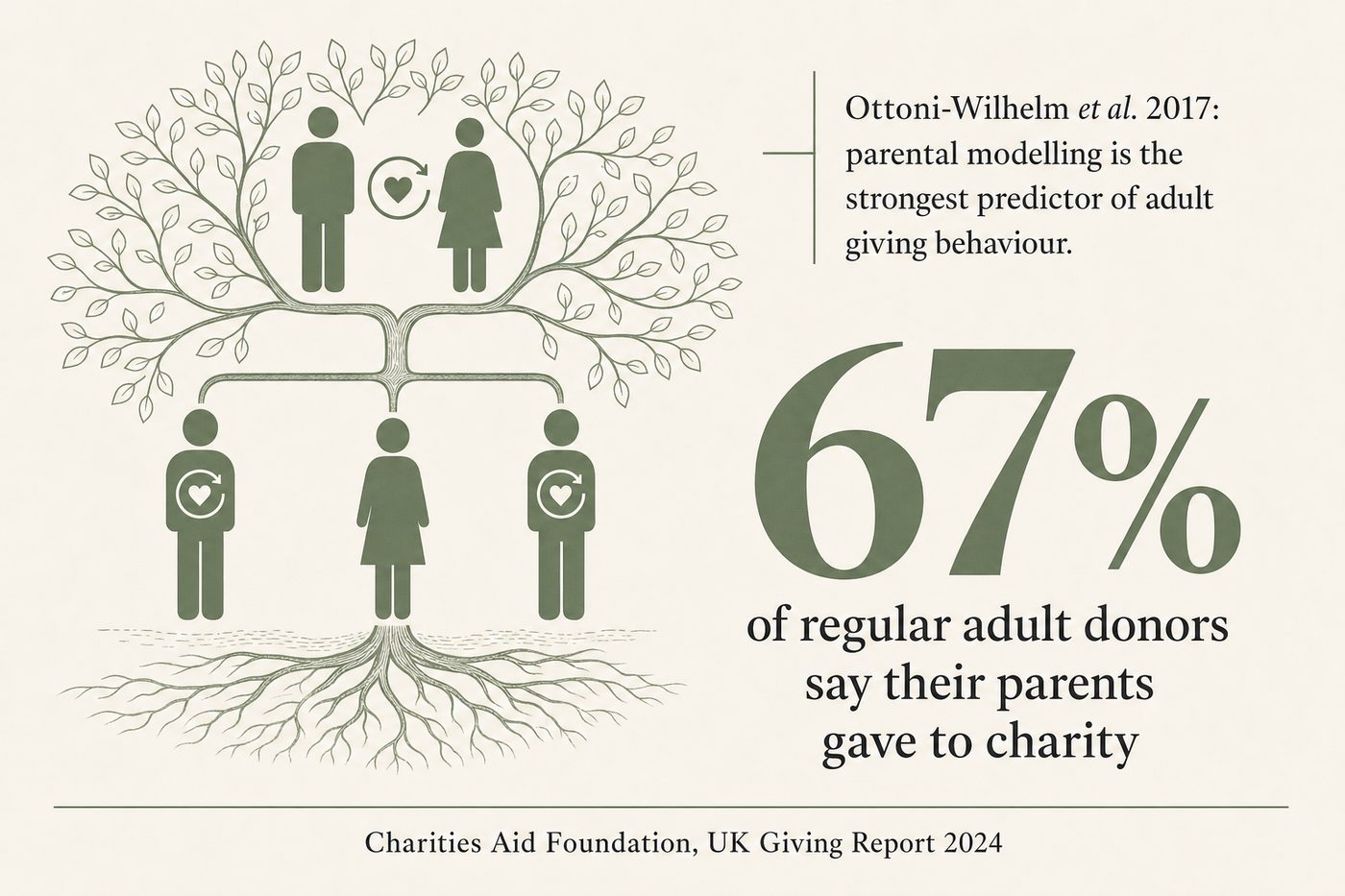
Turns out that's roughly the most effective thing they could have done. Ottoni-Wilhelm, Estell, and Perdue published a longitudinal study in 2017 called "Raising Charitable Children." They tracked families over decades. Their finding: the single strongest predictor of whether someone becomes a regular donor as an adult is whether they saw their parents donate when they were young. Stronger than income, education, religiosity, or political affiliation.
The Charities Aid Foundation backs this up with their own data. 67% of people who give regularly to charity report that their parents did the same. That's not a subtle correlation. Two thirds of habitual givers learned the habit at home.
Here's what's strange, though. Most families in wealthy countries don't talk about money with their children. A 2023 T. Rowe Price survey found that parents are more comfortable discussing drugs, alcohol, and puberty than household finances. Giving to charity falls somewhere between "our mortgage" and "how much I earn" on the list of things parents would rather not bring up.
So we have a behaviour that clearly transmits across generations, but most people transmit it accidentally, if at all.
What the research actually shows
The evidence on childhood giving behaviour is thinner than you'd expect. Most of the serious longitudinal work comes from a handful of studies, and the sample sizes aren't enormous. Still, the pattern is consistent enough to take seriously.
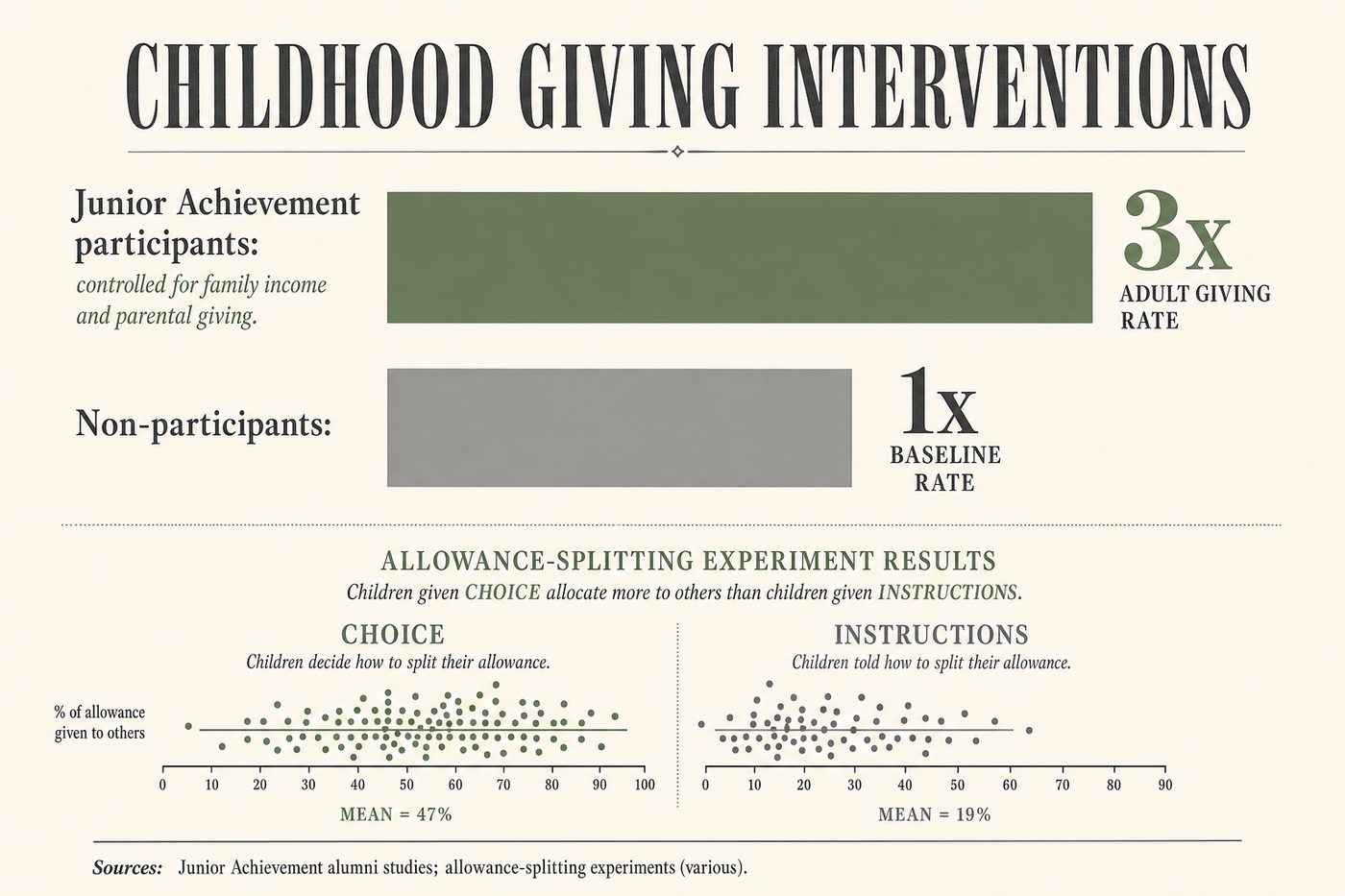
The Junior Achievement programmes in the US offer one of the cleaner natural experiments. Kids who participate in JA financial literacy programmes, which include a component on charitable giving, donate at roughly three times the rate of their peers in adulthood. The effect persists even after controlling for family income and parental giving behaviour. Something about being taught explicitly how giving works, at a young age, shifts the baseline.
Allowance-splitting experiments tell a similar story from a different angle. When researchers give children a small amount of money and let them choose how much to share with someone in need, kids who can see the recipient's situation allocate more. This is obvious, maybe. But the interesting part: kids who are given the choice to share, rather than told to share, develop a stronger ongoing preference for generosity. The sense of agency matters.
None of this is especially surprising if you think about how kids learn anything. They watch, they copy, and they form habits from whatever feels normal in their household. If giving is normal, giving becomes normal. If money is a taboo subject, generosity around money stays opaque.
The pipeline problem
Giving What We Can, the organisation that coordinates the 10% income pledge for effective giving, has over 9,000 pledgers as of 2025. They've helped direct $3.5 billion in pledged donations toward high-impact charities.
They have no mechanism for people under 18.
This isn't a criticism, exactly. There are good reasons not to ask teenagers to commit to lifetime financial pledges. But it points to a gap in the effective giving movement's pipeline. If the research says childhood habits are the strongest predictor of adult giving, and the effective giving community has no touchpoint with children or families, then the movement is ignoring its own best recruitment channel.
A handful of smaller organisations have tried to fill this gap. Giving games, developed partly by The Life You Can Save, let groups (including school groups) allocate real money to charities and discuss the reasoning. GiveDirectly ran a few pilot programmes with schools in 2022. These are small experiments, mostly unfunded, and none of them have been rigorously evaluated.
Compare this with financial literacy. There are dozens of well-funded programmes teaching kids about saving, budgeting, investing, and compound interest. The idea that children should learn about money is uncontroversial. The idea that they should also learn about giving money away barely registers.
What parents actually do
Do Gooder
One good decision a week
The research behind each piece takes hours. Get the next evidence-backed read every Tuesday, in 3 minutes.
Free weekly read. Unsubscribe anytime, no guilt.
I asked around. Informally, among friends and in online communities for parents interested in effective giving. The approaches vary wildly.
Some families give each kid a small monthly allowance split three ways: spend, save, give. The kid chooses where the "give" portion goes. This is the most common model I heard about, and it maps reasonably well onto the research. The kid has agency, sees the act of giving as routine, and occasionally has to think about where the money does the most good.
Other parents involve kids in their own giving decisions. One friend shows her nine-year-old the GiveWell website and explains, in simple terms, why they give to Against Malaria Foundation instead of the local animal shelter. The kid doesn't fully get cost-effectiveness analysis (who does, at nine?) but understands the basic concept: some places stretch your money further than others.
A few parents told me they deliberately avoid talking about their giving because they don't want it to feel performative. This is a real concern. Charitable giving that becomes a self-congratulatory ritual loses something important. But the research suggests that visibility matters more than presentation. Kids who see giving happen, even imperfectly, develop the habit more reliably than kids who don't.
The uncomfortable bit
There's something slightly manipulative about deliberately shaping your child's giving behaviour. I don't think it's wrong, but I notice the discomfort. We're comfortable saying we want our kids to be kind, generous, and thoughtful. We're less comfortable admitting that "generous" means "gives money to specific causes I've evaluated as effective," and that modelling this behaviour is basically a soft form of persuasion.
It's the same tension that runs through all parenting. You're forming a person. Every value you model is a choice you're making on their behalf, before they can evaluate it themselves. Teaching your kid to eat vegetables is also a form of persuasion. We just don't feel weird about it because vegetables are less ideologically loaded than utilitarian philanthropy.
The pragmatic answer is: model the behaviour, explain your reasoning when asked, and let them reach their own conclusions eventually. Some will keep giving. Some won't. The evidence says more will than won't, if you start early.
Practical steps
If you're a parent and you care about this, the research points toward a few specific things.
Let your kids see you give. Standing orders are invisible. Mention them occasionally. When you make a donation decision, say why out loud, even briefly.
Give them real money to allocate. Small amounts, regularly. Let them choose. Ask what they picked and why, but don't grade their answers.
Don't overthink the age. Five-year-olds can understand "some people don't have enough, and we can help." They don't need to understand QALYs.
Find or create a giving game for their school. The Life You Can Save has materials. If nothing formal exists, a class discussion about "if you had £100 to help people, where would it do the most good?" works fine.
If you're in the effective giving community: think about whether there's a real product here. A GWWC for families. A junior pledge. An app that lets kids track their giving the way Ecosia lets them track trees. Nobody's built it yet, which either means it's a bad idea or an under-explored one.
Sources used
- Ottoni-Wilhelm, M., Estell, D. B., & Perdue, N. H. (2017) "Raising Charitable Children" Journal of Moral Education
- Charities Aid Foundation (CAF) UK Giving Report (2024): parental giving correlation data
- Junior Achievement longitudinal alumni studies (various years, compiled 2021)
- T. Rowe Price "Parents, Kids & Money" survey (2023)
- Giving What We Can pledge data (9,000+ pledgers, $3.5B pledged, 2025)
- The Life You Can Save giving games programme documentation
- GiveDirectly school pilot programme reports (2022)
More in The Life Edit