The browser extension that gives
8 May 2026 · 6 min read
I installed Tab for a Cause about three years ago. I open a lot of browser tabs. Every time I do, a small ad loads on the new tab page, and the revenue goes to charity. I've raised something like $40 without thinking about it, without changing any behaviour, without spending a penny of my own money.
This is either the future of micro-philanthropy or a rounding error dressed up as impact. I go back and forth.
How passive giving tools work
The business model is the same across most of these tools. You install something, a browser extension, a search engine, a shopping plugin. It generates ad revenue or affiliate commissions from your normal internet behaviour. That revenue goes partly to the company running the tool and partly to charitable causes.
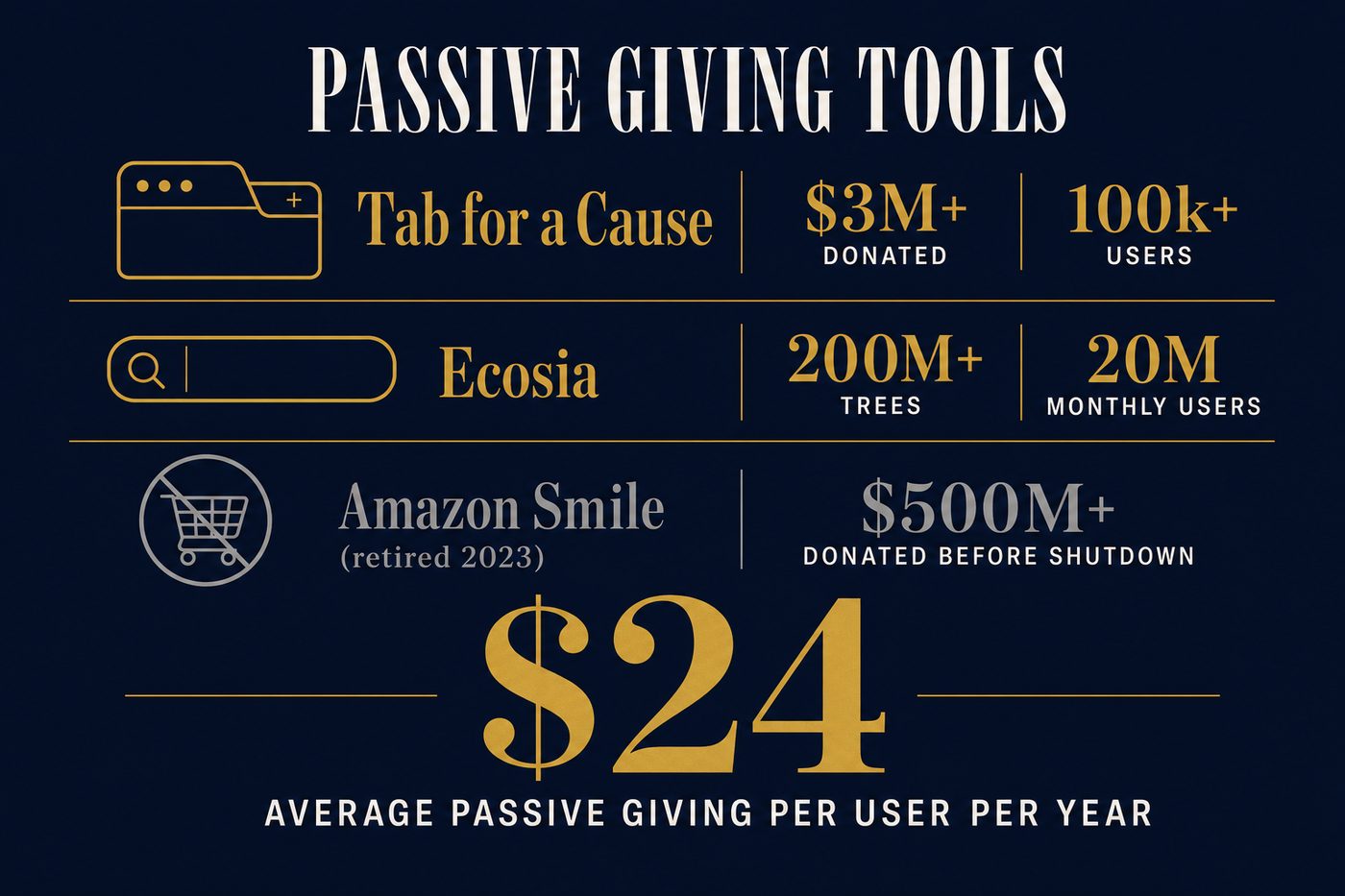
Tab for a Cause is the simplest version. You install the Chrome extension. Every new tab shows a small banner ad. You earn "hearts" that you can direct to partner charities. The extension has over 100,000 active users and has donated more than $3 million since it launched. The individual amounts are tiny. The aggregate is not.
Ecosia is the bigger play. It's a search engine, Berlin-based, that plants trees with its ad revenue. Over 20 million monthly active users as of 2025, and more than 200 million trees planted. The maths works out to roughly one tree per 45 searches, though that ratio varies by ad market and season. You switch your default search engine, you search the web like normal, and trees get planted.
Amazon Smile used to be the obvious entry point for passive giving, but Amazon shut it down in February 2023. The programme directed 0.5% of eligible purchase prices to a charity of your choice. Amazon said it hadn't generated enough impact to justify the costs. Which is a strange framing, because it had donated over $500 million to charities by the time it closed.
The remaining shopping-based tools, like Giving Assistant and the browser extension from PayPal Giving Fund, work similarly but have much smaller user bases. Most people haven't bothered replacing Amazon Smile.
The numbers, honestly
The average passive giving tool generates about $24 per user per year. That figure comes from aggregating publicly reported donation totals against active user counts for Tab for a Cause, Ecosia, and the now-defunct Amazon Smile.
$24 a year is roughly 7p a day. Per person, it's nothing. If you have 20 million users, it's $480 million a year. Ecosia alone accounts for most of that.
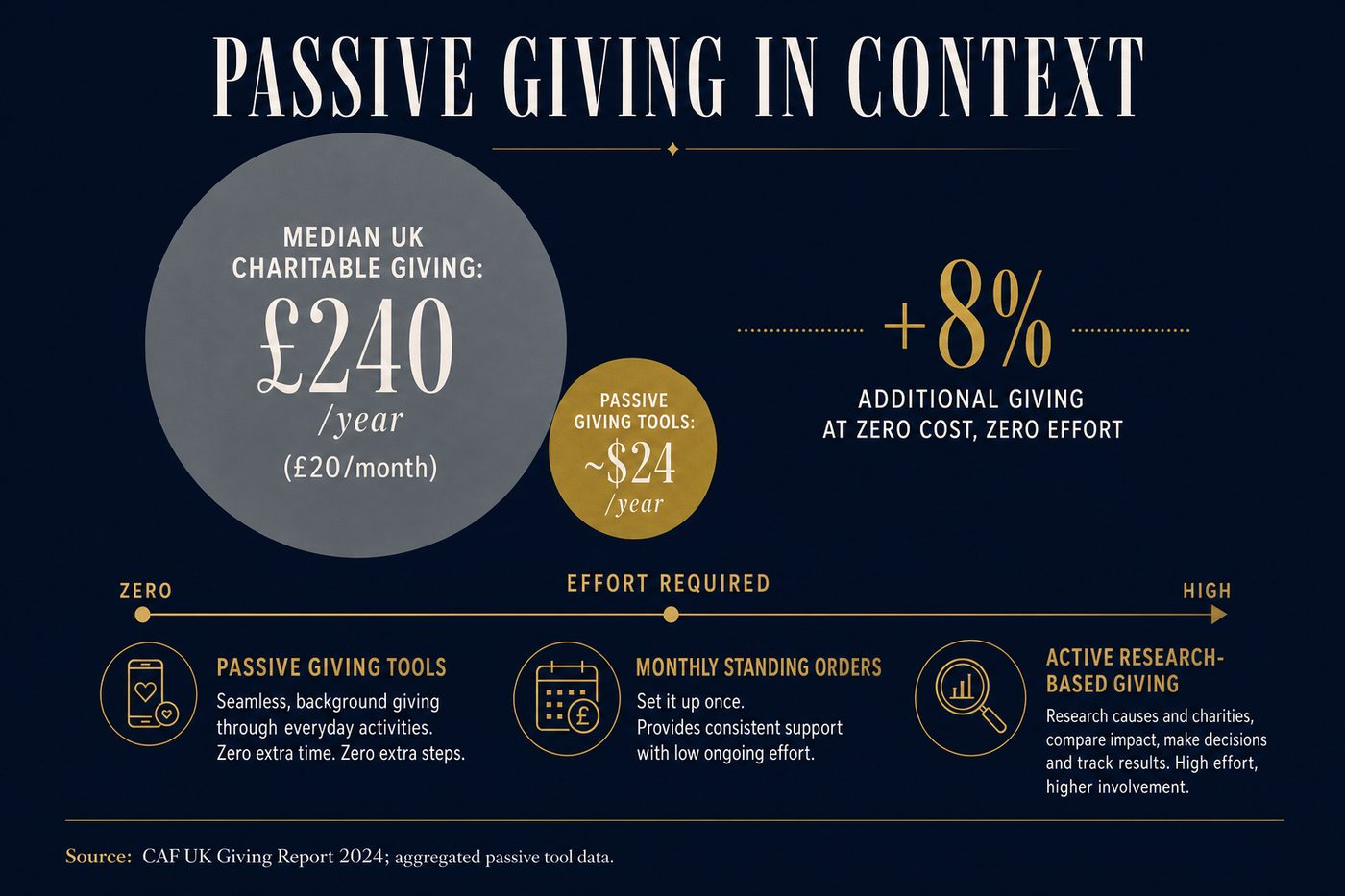
But context matters. The median charitable donation in the UK is about £20 per month according to the CAF Giving Report. $24 a year from a passive tool is an 8% addition to median giving, at zero cost, with zero effort, requiring zero ongoing decisions. For people who don't donate at all (which is most people in most countries), it's infinitely more than what they'd otherwise give.
The objection is obvious: these tools give to whatever charities they partner with, not to the most effective charities. Tab for a Cause lets users choose from a curated list that includes Room to Read, Save the Children, and Action Against Hunger. Solid organisations, but not GiveWell-recommended. Ecosia plants trees, which is worthwhile but wouldn't rank high on most cost-effectiveness analyses.
If you're reading this site, you probably care about where the money goes, not just that it goes somewhere. Fair enough. But the counterfactual for most passive giving users is zero. They weren't going to donate to Against Malaria Foundation. They weren't going to donate at all. Raising $24 for Save the Children from someone who would have given nothing is still $24 that didn't exist before.
The workplace version
Do Gooder
One good decision a week
The research behind each piece takes hours. Get the next evidence-backed read every Tuesday, in 3 minutes.
Free weekly read. Unsubscribe anytime, no guilt.
Benevity is the corporate version of this idea, and it's massive. It's a workplace giving platform that handles payroll deductions, donation matching, and volunteer tracking for large employers. Since launch, over $12 billion has moved through the platform. Their client list includes Apple, Google, Microsoft, Nike, and a few hundred other household names.
The mechanism is different from browser extensions, but the principle is the same: reduce the friction to near zero and aggregate small individual contributions into large totals. Benevity makes giving a checkbox in your HR portal. You tick it once, and a small amount leaves your paycheque every month.
The $12 billion figure includes corporate matching, which inflates the number. Still, the volume is real. Benevity's own data suggests that employees who use the platform give 2-3x more than they would through traditional channels. The act of making it effortless changes the amount.
What went wrong with Amazon Smile
Amazon Smile is worth dwelling on for a moment, because its death says something uncomfortable about passive giving.
Amazon framed the shutdown as a strategic decision: the programme generated too little impact relative to its operational costs. But $500 million over ten years is not nothing. The real issue was probably that Amazon Smile created a customer expectation (Amazon supports my charity) without generating enough goodwill to justify the brand cost of running it.
The lesson for passive giving tools: they survive only as long as the business model works for the company running them. Ecosia and Tab for a Cause are structured differently (Ecosia is a social enterprise, Tab for a Cause runs lean). But any tool that depends on ad revenue is one algorithm change away from becoming unviable.
This isn't a reason not to use them. It's a reason not to treat them as your entire giving strategy.
Should effective altruists care?
Mixed feelings here. On one hand, the amounts per person are tiny, the charity selection is suboptimal, and the whole thing can create a false sense of "I'm already doing my part" that substitutes for actual giving. The licensing effect in behavioural economics: people who do a small good deed feel they've earned a pass on bigger ones.
On the other hand, the evidence on licensing is actually weaker than most people think. A 2022 meta-analysis in Organizational Behavior and Human Decision Processes found the effect size for moral licensing was small and inconsistent across studies. Some research suggests the opposite: small acts of generosity prime people for larger ones. The "foot in the door" effect.
The practical answer is probably boring. Use the tools. They cost nothing. Don't count them as your charitable giving. If you're already donating 1-10% of your income to effective charities, adding $24 of passive giving through Tab for a Cause harms nobody. If you're not donating at all, Tab for a Cause is a better starting point than nothing.
What I'd really like to see is an effective altruist version of these tools. A browser extension where the ad revenue goes to GiveWell's top charities. A search engine where every 45 searches buys a bednet instead of planting a tree. These don't exist yet, as far as I can tell. They probably should.
Sources used
- Tab for a Cause: public donation counter and user metrics ($3M+ donated, 100k+ active users)
- Ecosia impact reports (20M+ MAU, 200M+ trees, ~1 tree per 45 searches)
- Amazon Smile programme data and February 2023 shutdown announcement
- Charities Aid Foundation UK Giving Report (2024): median giving data
- Benevity platform data ($12B+ total giving, client list, employee giving multiplier)
- Blanken, I., van de Ven, N., & Zeelenberg, M. (2015) "A Meta-Analytic Review of Moral Licensing" updated in Organizational Behavior and Human Decision Processes (2022)
- Freedman, J. L. & Fraser, S. C. (1966) "Compliance without pressure: the foot-in-the-door technique" JPSP
More in Small Acts