The warm glow trap
5 May 2026 · 7 min read
In 1990, economist James Andreoni published a paper called "Impure Altruism and Donations to Public Goods: A Theory of Warm-Glow Giving." The central insight: people don't just give because they want to help. They give because giving itself feels good. The warm glow, the internal reward signal, the satisfaction of "doing your part," these fire regardless of whether your donation actually accomplished anything.
This isn't a minor footnote in behavioural economics. It's the single biggest explanation for why charitable giving is so catastrophically misallocated. The warm glow doesn't discriminate. You get the same neural reward from a $50 donation to a well-marketed but ineffective charity as from a $50 donation that saves a child's life. Your brain can't tell the difference. So it doesn't try.
Three cognitive traps that exploit the glow
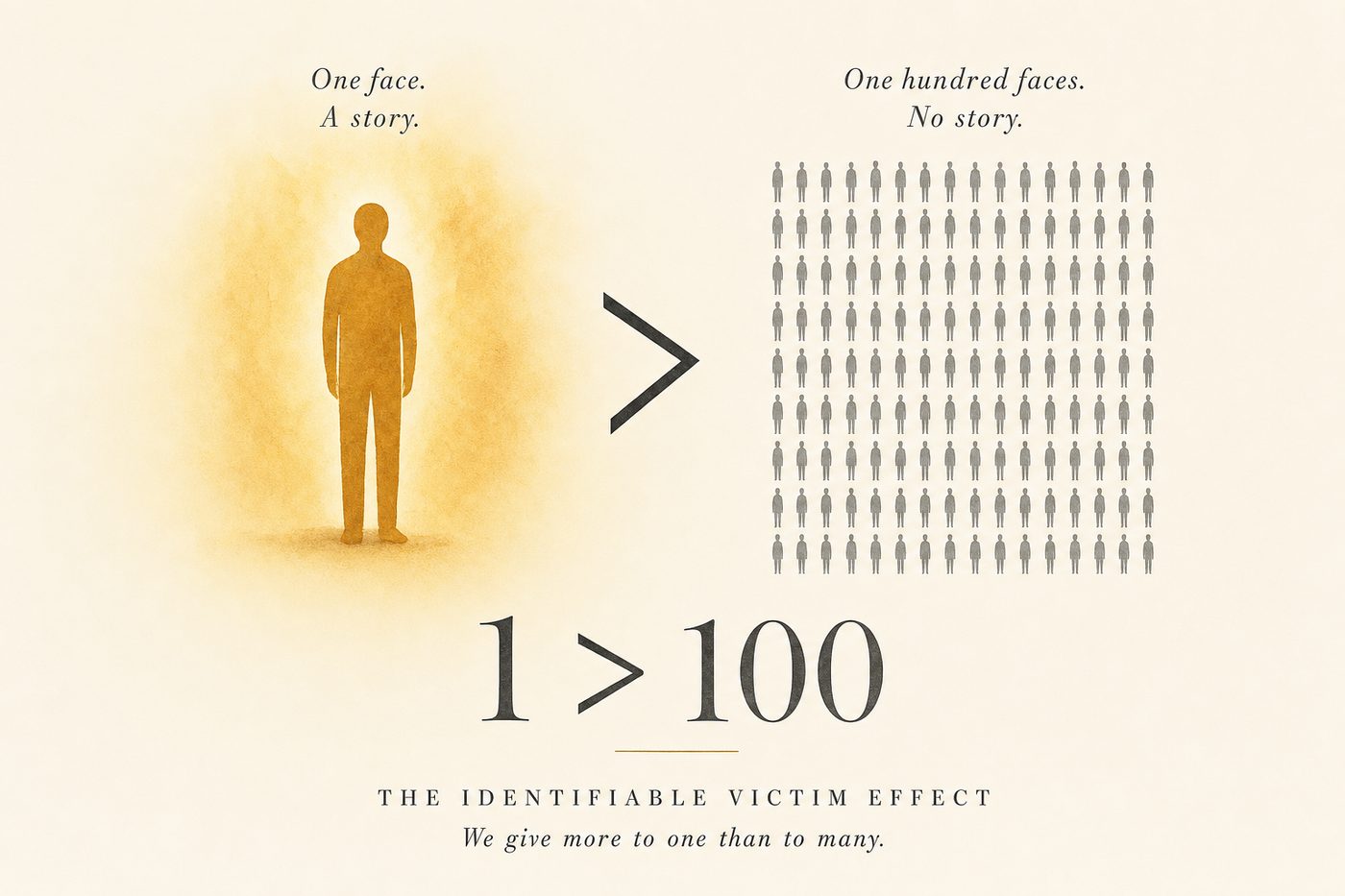
1. The identifiable victim effect. Paul Slovic and colleagues demonstrated this repeatedly: show people a photo and name of one hungry child, and they donate generously. Show them statistics about millions of hungry children, and donations drop. Show them both the individual story and the statistics together, and donations still drop compared to the individual alone.
The mechanism is cruel. Statistics activate analytical thinking, which dampens the emotional response that drives giving. Dickert, Sagara, and Slovic (2011) found that asking people to do simple maths problems before reading a donation appeal significantly reduced giving. The analytical frame suppresses compassion.
This means charities that use individual stories raise more money than charities that present evidence of impact. The incentive structure rewards emotional marketing over demonstrated effectiveness. Donors feel they're making the "right" choice because it feels intense and personal. They're systematically selecting for narrative skill over lifesaving ability.
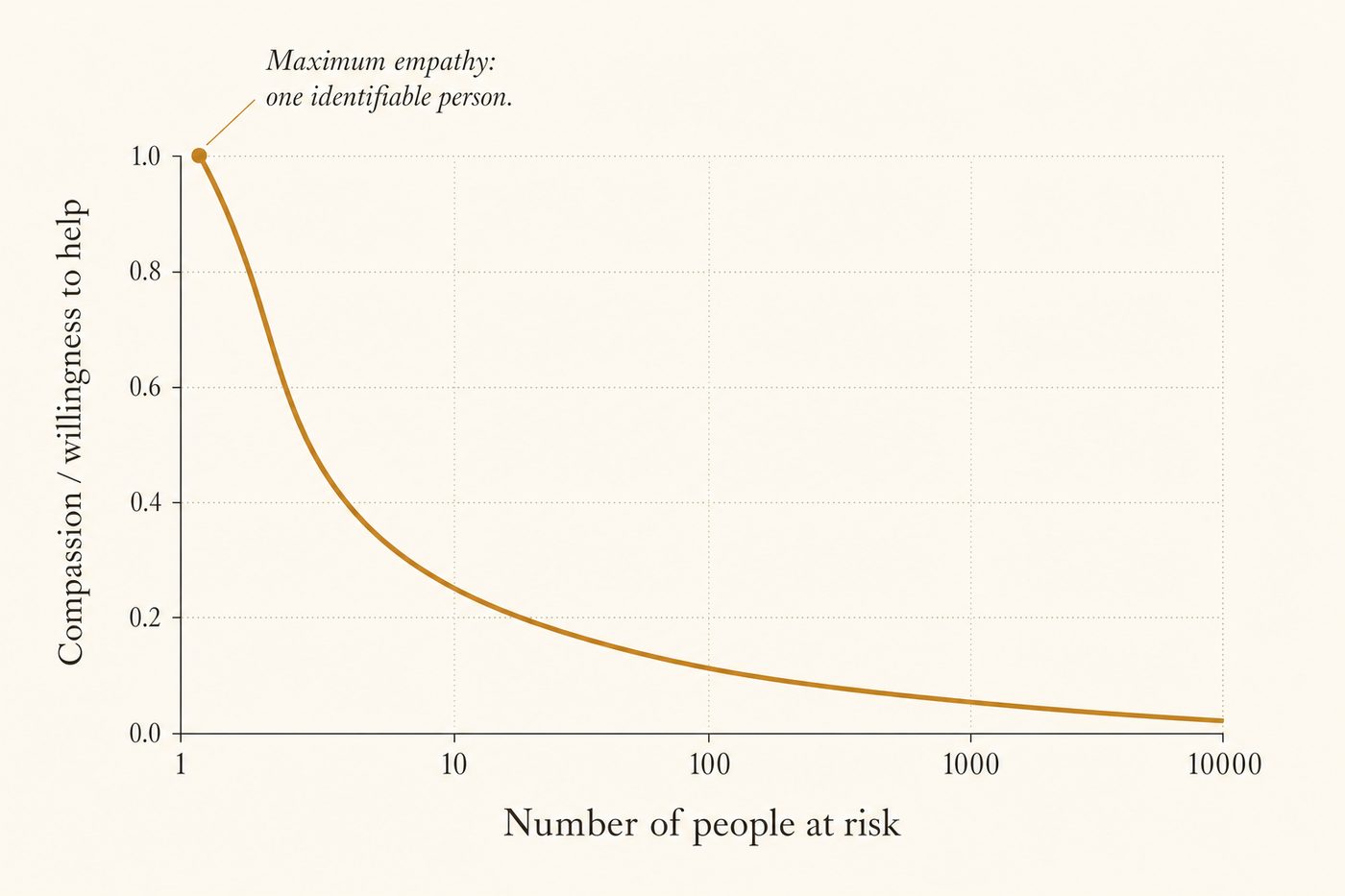
2. Psychic numbing and scope insensitivity. Slovic's related finding: the subjective value of saving a life decreases as the number at risk increases. One death is a tragedy. A million deaths is a statistic. But it's worse than that. Research shows that the value of saving a life diminishes starting from the very first life at risk. One person in danger triggers maximum compassion. The same person as the 88th at risk triggers measurably less.
For effective giving, this is devastating. The causes where donations do the most good are precisely the ones involving vast, abstract numbers of beneficiaries. Deworming 280 million children. Distributing 300 million bed nets. Treating 500,000 people for depression. These numbers should make us give more. Instead, our brains treat them as noise.
3. Overhead fixation. Donors disproportionately weight overhead ratios (admin spending as a percentage of total) when choosing charities, despite decades of evidence that overhead bears no relationship to impact. A charity spending 25% on administration might be investing in evaluation systems, staff development, and technology that makes their programmes dramatically more effective. A charity spending 5% on admin might be running on volunteer burnout and blind faith.
The warm glow explains why: low overhead feels virtuous. "95 cents of every dollar goes directly to the cause" triggers the glow of maximum efficiency, even though efficiency without effectiveness is worthless. You can very efficiently do nothing useful.
The scale of misallocation
Recent experimental research categorised donors into Pure Altruists (19.6%), Warm Glow Types (31.1%), and Other (49.3%). Nearly a third of donors are primarily motivated by how giving makes them feel rather than what it accomplishes. Add the "Other" category (which includes social pressure, tax benefits, and habit), and the proportion driven primarily by impact shrinks to under a fifth.
At the population level, this produces predictable distortions:
Disaster response gets funded. Prevention doesn't. Earthquake relief triggers massive warm glow because the suffering is visible, acute, and identifiable. Earthquake-resistant building codes in developing countries, which would prevent orders of magnitude more deaths, trigger no emotional response whatsoever. They're boring, abstract, and preventive. They save more lives per dollar by factors of 10 to 100.
Cute animals beat cost-effectiveness. UK donors give over £1 billion per year to animal charities, primarily domestic animal welfare (cats, dogs, horses). The Animal Charity Evaluators' top-recommended organisations, which address the suffering of billions of factory-farmed animals, collectively receive a fraction of that amount.
Local beats global by default. Donors give more to geographically proximate causes despite radically lower cost-effectiveness, because proximity makes beneficiaries more identifiable and the warm glow stronger.
What the warm glow is actually telling you
Do Gooder
One good decision a week
The research behind each piece takes hours. Get the next evidence-backed read every Tuesday, in 3 minutes.
Free weekly read. Unsubscribe anytime, no guilt.
The warm glow isn't a flaw to be eliminated. It's the evolved mechanism that makes generosity psychologically sustainable. Without it, long-term giving collapses. The problem isn't feeling good about giving. The problem is using how you feel as a proxy for how much good you did.
The fix isn't to suppress emotion. Research shows that donors who try to give purely analytically often stop giving altogether because the emotional reward disappears. The fix is to separate the allocation decision from the emotional experience.
Decide with data, then feel with stories. Choose your recipients based on evidence of impact (GiveWell, Animal Charity Evaluators, Founders Pledge). Then, after you've made the allocation, read the stories and updates from those organisations. The warm glow still fires. You still feel it. But it fires in response to genuinely effective work rather than maximally manipulative marketing.
Pre-commit your allocation. Set up a monthly standing order to evaluated charities. This takes the allocation decision out of the emotional moment. You never face a fundraising appeal where the identifiable victim effect can redirect your giving away from where it counts.
Track your "emotional" budget separately. Some giving advice suggests having a small "warm glow budget" (maybe 10-20% of total giving) that you direct based on personal connection, emotional response, and relationship. The friend's marathon. The local food bank at Christmas. The disaster appeal. This acknowledges the psychological need without letting it corrupt your primary allocation.
The honest accounting
The charitable sector receives roughly $500 billion per year globally. If even 10% were reallocated from warm-glow-optimised choices to impact-optimised ones, the improvement in human welfare would be extraordinary. The 100x gap between the most and least effective charities working on the same problem means that misallocation isn't a minor inefficiency. It's the difference between thousands of lives saved and millions.
Your warm glow is not your enemy. But it's not your compass either. Use it as fuel, not navigation.
Sources used
- Andreoni, J. (1990) "Impure Altruism and Donations to Public Goods: A Theory of Warm-Glow Giving." Economic Journal.
- Slovic, P. (2007) "If I look at the mass I will never act: Psychic numbing and genocide." Judgment and Decision Making.
- Small, D., Loewenstein, G. & Slovic, P. (2007) "Sympathy and callousness." Organizational Behavior and Human Decision Processes.
- Dickert, S., Sagara, N. & Slovic, P. (2011) "Affective motivations to help others." Judgment and Decision Making.
- Västfjäll, D., Slovic, P. et al. (2014) "Compassion Fade: Affect and Charity Are Greatest for a Single Child in Need." PLOS One.
- Bergh, R. & Reinstein, D. (2021) "Empathic and Numerate Giving." Social Psychological and Personality Science.
- Crumpler, H. & Grossman, P.J. (2008) "An Experimental Test of Warm Glow Giving." Journal of Public Economics.
More in The Receipts