The climate charity map
5 May 2026 · 7 min read
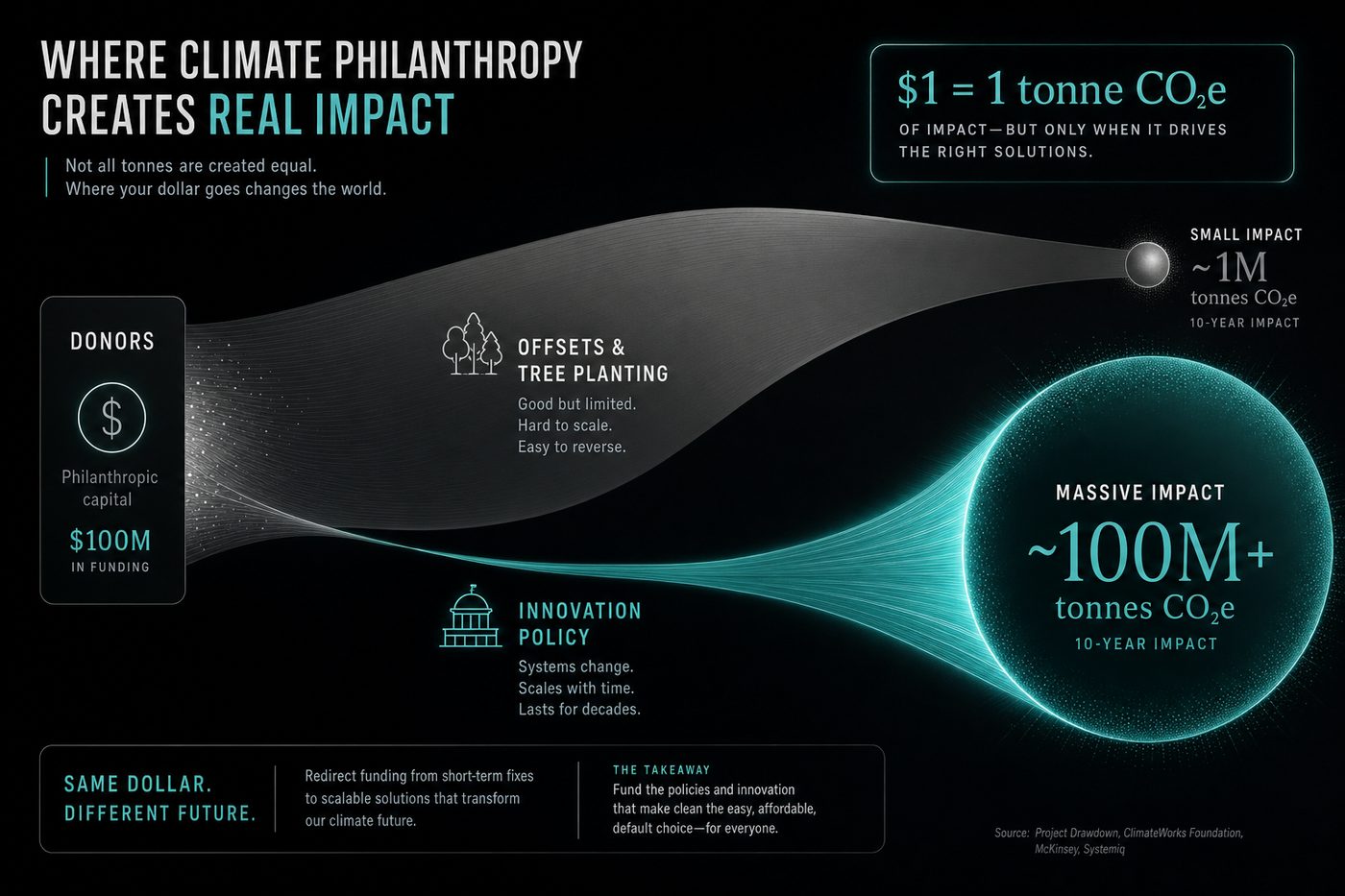
If you care about climate change and want to donate effectively, you face a problem: the most obvious climate charities are not the most impactful ones. Tree-planting campaigns, carbon offset providers, and consumer awareness nonprofits absorb the majority of individual climate donations. Meanwhile, the interventions with the strongest evidence of systemic impact are chronically underfunded.
The gap is staggering. Founders Pledge estimates that every dollar donated to their top climate pick, the Clean Air Task Force, reduces more than one tonne of CO2 equivalent. Compare that to voluntary carbon offsets, where verification problems mean many credits represent emissions reductions that never actually happened (see Verra's 90% phantom credit scandal, reported by The Guardian in 2023).
The evaluators: who maps this space
Three organisations do rigorous climate charity evaluation. Their methodologies differ, but their top picks converge.
Founders Pledge Climate Fund. The most established evaluator in this space. Their Climate Change Fund had deployed almost $29 million by the end of 2024, through 27 grants to 13 organisations and projects plus a network of more than 20 orgs through re-granting partners. They received a $50 million anonymous donation in mid-2025 (on top of a $40 million anonymous gift the year before), signalling serious institutional confidence. Their framework prioritises neglected technologies and policy advocacy over deployment and consumer behaviour change.
Giving Green. Founded specifically to answer "where should climate-concerned donors give?" Giving Green announced $26 million for high-impact climate solutions in their 2025-2026 cycle. Their framework identifies strategies with potential for major warming decreases, where philanthropy can meaningfully accelerate progress, and where relative neglect from other funders creates leverage. In 2025, they identified eight priority strategies spanning food systems, aviation/maritime, heavy industry, geothermal, nuclear, and low/middle-income energy transitions.
GWWC Climate Fund. Giving What We Can's climate allocation pools donor funds across evaluated climate charities. Less methodologically original than Founders Pledge or Giving Green, but useful for donors who want diversified exposure.
The top picks: where evaluators agree
Three organisations appear consistently across evaluator recommendations.
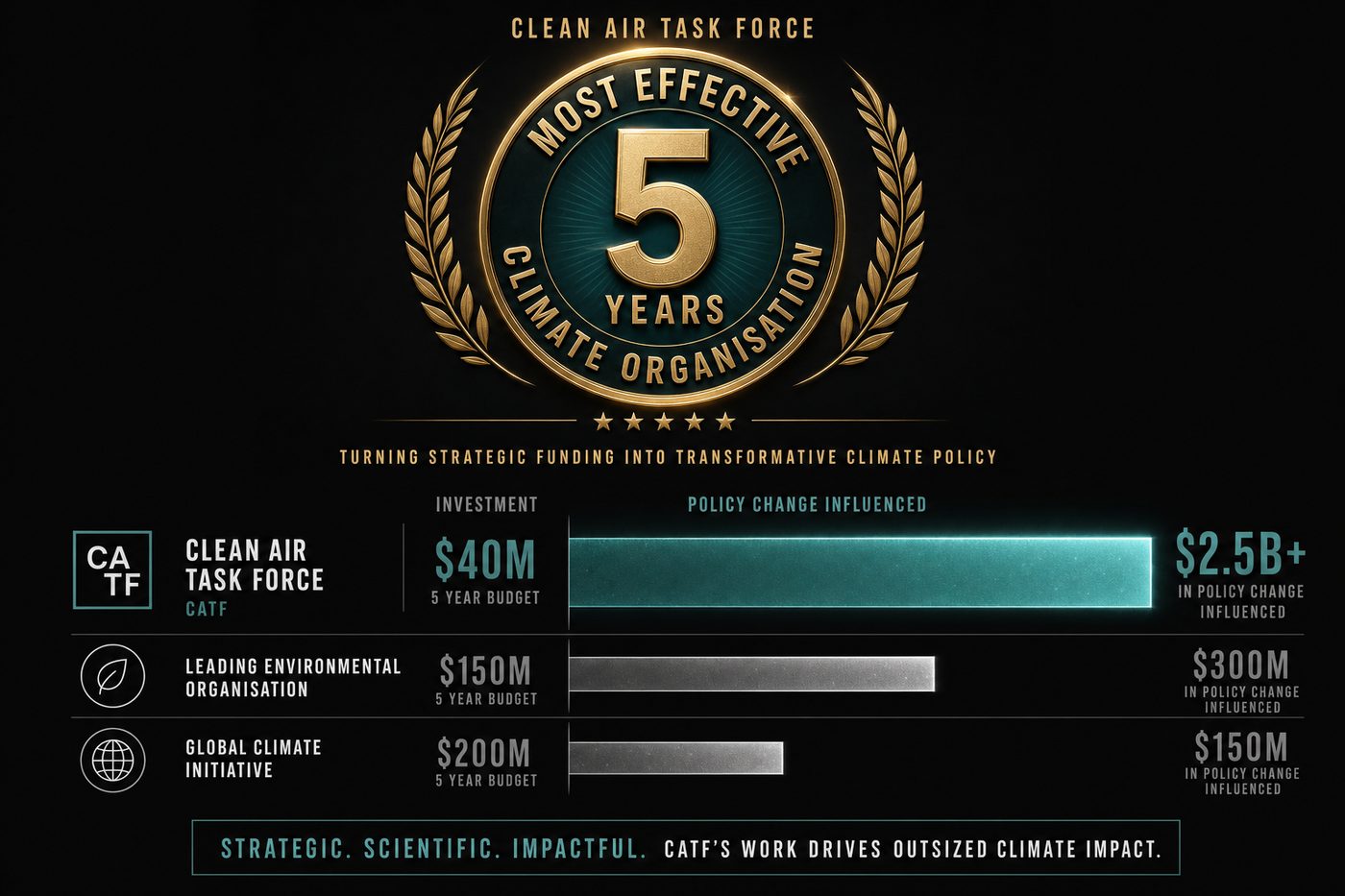
Clean Air Task Force (CATF). Named most effective climate organisation by Founders Pledge for five consecutive years. CATF advocates for policy and innovation in neglected low-carbon technologies: advanced nuclear, superhot rock geothermal, carbon capture, clean hydrogen. They don't pick technology winners. They push governments to fund research and remove regulatory barriers across the board. Their theory of change: the world needs many more clean energy options than wind and solar alone, and private markets won't develop them without policy support. CATF runs on a budget in the tens of millions of dollars a year, tiny relative to the policy change they influence.
Carbon180. Focused specifically on carbon removal policy. Carbon180 was instrumental in shaping the 45Q tax credit for carbon capture in the US Inflation Reduction Act. They bridge the gap between carbon removal researchers and policymakers, translating technical potential into legislative action. Their work is highly complementary to CATF: where CATF pushes for clean energy innovation broadly, Carbon180 focuses on the removal side of the equation.
Future Clean (formerly TerraPraxis). Focused on repowering coal plants with clean heat sources. Founders Pledge made a multi-year grant to support their work converting existing coal infrastructure to nuclear or geothermal energy. This approach is unusually tractable because it reuses existing grid connections and turbines, dramatically reducing costs compared to greenfield nuclear construction.
What makes climate giving different
Do Gooder
One good decision a week
The research behind each piece takes hours. Get the next evidence-backed read every Tuesday, in 3 minutes.
Free weekly read. Unsubscribe anytime, no guilt.
Climate philanthropy operates differently from global health giving, and the differences matter.
No cost-per-life equivalent. In global health, GiveWell can estimate cost per life saved ($5,500 for bed nets). In climate, there's no equivalent single metric. You're buying policy change, technology development, or advocacy outcomes. The counterfactual is harder to establish: did this $1 million grant cause this policy to pass, or would it have passed anyway?
Leverage through policy. The highest-impact climate donations don't directly reduce emissions. They change the policy environment so that trillions of dollars in government and private investment flow differently. CATF runs on a budget in the tens of millions, yet the policies it has influenced have mobilised far more. That leverage ratio is why evaluated climate charities dramatically outperform individual offset purchases.
Neglectedness within neglectedness. Even within climate philanthropy, certain areas receive almost no funding. Giving Green has flagged non-CO2 effects, including aviation contrails, as badly underfunded relative to their impact. Including non-CO2 effects, aviation has accounted for an estimated 3.5-4% of global temperature rise to date, and rerouting flights to avoid contrail-forming conditions is one of the cheaper levers available. Yet almost nobody funds it, because it's obscure and unglamorous.
What most donors get wrong
Buying offsets instead of policy. Voluntary carbon offsets are the default "climate donation" for most people. But offset markets have fundamental integrity problems (additionality, permanence, verification), and even perfect offsets only neutralise your own footprint rather than changing the system. A donation to CATF that shifts energy policy potentially abates millions of tonnes. Your $20/month offset subscription abates your personal 10 tonnes, maybe.
Funding renewables deployment in rich countries. Solar and wind in developed markets are already economically competitive. They'll scale with or without philanthropic support because the economics now favour them. Philanthropic leverage is minimal. Funding nuclear or geothermal innovation, where private capital won't invest without policy certainty, offers far higher marginal returns.
Conflating visibility with impact. Tree planting is visible, photographable, and emotionally satisfying. Policy advocacy for advanced nuclear reactor licensing reform is invisible, abstract, and dull. The latter has orders of magnitude more climate impact per dollar. The most effective climate donors learn to fund boring things that change systems rather than photogenic things that change feelings.
How to allocate
If you're donating to climate specifically (rather than treating it as one cause area within a broader effective giving portfolio):
Simple version. Give to the Founders Pledge Climate Fund or the Giving Green Fund. Both aggregate across their evaluated picks and rebalance as opportunities shift. You get diversified exposure to the best-evaluated climate charities without needing to track the space yourself.
Direct version. Split between CATF (innovation policy broadly), Carbon180 (removal specifically), and one frontier bet from Giving Green's newer recommendations (geothermal, nuclear, or LMIC clean energy transitions).
What to avoid. Consumer-facing offset platforms, tree planting unless it's REDD+ with verified permanence, awareness campaigns with no theory of policy change, and any organisation that can't articulate why philanthropic dollars change their trajectory (as opposed to government or market funding that would arrive regardless).
The climate charity map is smaller and more legible than it appears. Three evaluators, a dozen top organisations, and a clear principle: fund the neglected innovations and policy changes that drive system-level change, not the visible interventions that make donors feel good without shifting trajectories.
Sources
- 40 million more ways to tackle the climate crisis (Founders Pledge): Climate Fund deployed almost $29M via 27 grants to 13 orgs, accessed June 2026
- $50M Anonymous Donation Powers Climate Solutions in a Pivotal Moment (Founders Pledge), accessed June 2026
- Giving Green Announces $26 Million for High-Impact Climate Solutions, 2025 to 2026 Top Climate Nonprofits (Giving Green), accessed June 2026
- Where to Give for Climate Impact in 2025: Giving Green's Priorities (Giving Green), accessed June 2026
- Giving Tuesday: Founders Pledge and Vox again recognize CATF as a top climate charity, recommended every year since 2021 (Clean Air Task Force), accessed June 2026
- How Much Does It Cost to Save a Life, roughly $5,500 per life via bed nets (GiveWell), accessed June 2026
- Phantom credits: 90% of rainforest carbon offsets certified by leading global standard, Guardian, Die Zeit and SourceMaterial investigation, Jan 2023 (Business and Human Rights Resource Centre), accessed June 2026
More in The Map