The lead crisis nobody talks about
3 May 2026 · 7 min read
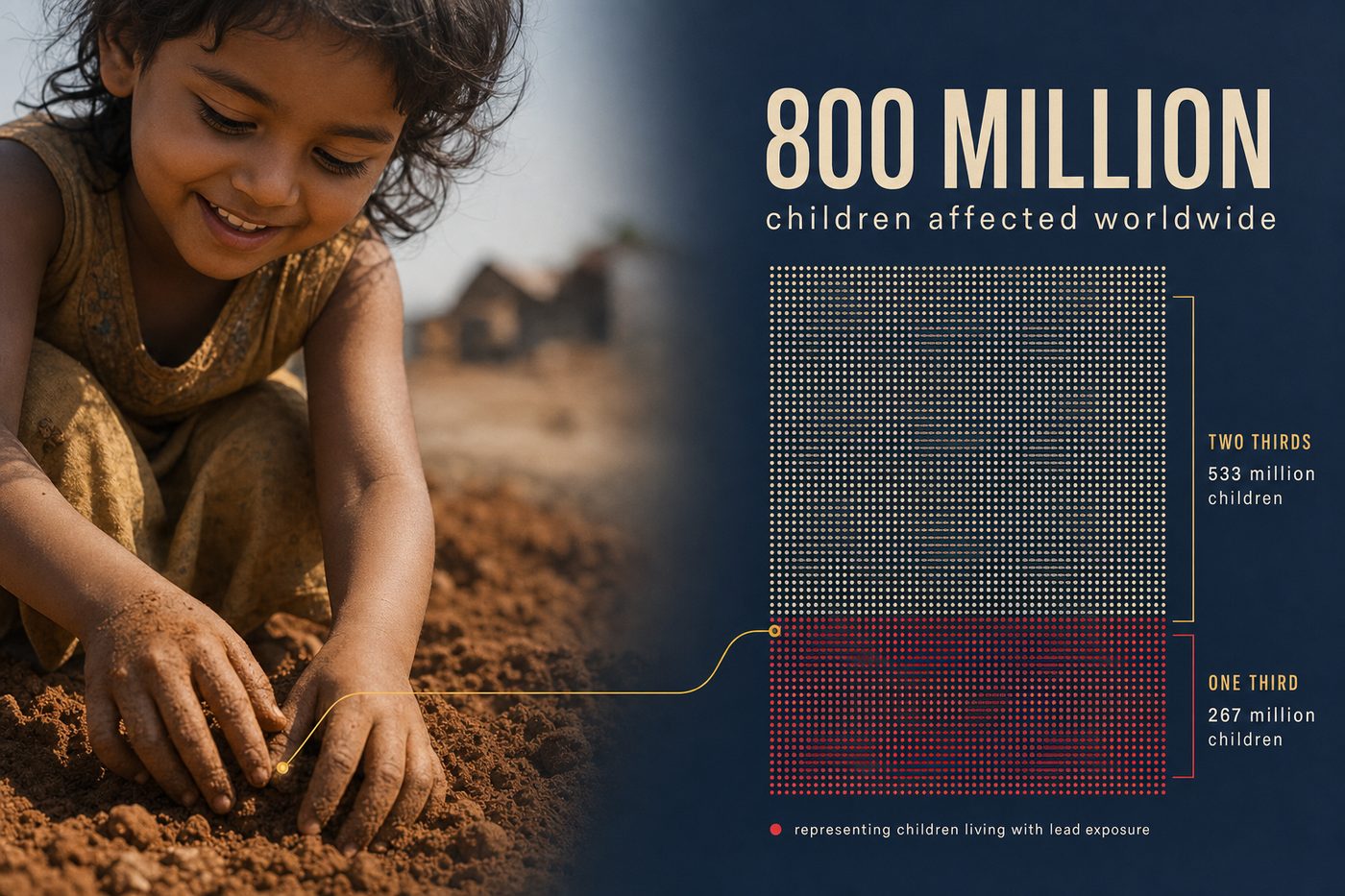
In 2020, UNICEF and Pure Earth published a study that should have been front-page news in every country on earth. One in three children globally, roughly 800 million, had blood lead levels above 5 micrograms per decilitre, the threshold at which cognitive damage begins. The majority were in low and middle-income countries. The study barely made the news cycle.
Lead poisoning is not a historical curiosity. It is not something the developed world solved in the 1980s when we banned leaded petrol. It is happening right now, at industrial scale, to hundreds of millions of children, and it is one of the most neglected crises in global health.
What lead does to a developing brain
Lead is a neurotoxin. There is no safe level of exposure. The damage is dose-dependent, cumulative, and largely irreversible.
Children in low and middle-income countries lose an average of 5.9 IQ points from lead exposure in early childhood (Lancet Planetary Health, 2023). That is not a rounding error. Five IQ points shifts a population's entire distribution. It moves the median. It shrinks the right tail where scientists, engineers, and physicians come from. It expands the left tail where learning disabilities and diminished economic participation concentrate.
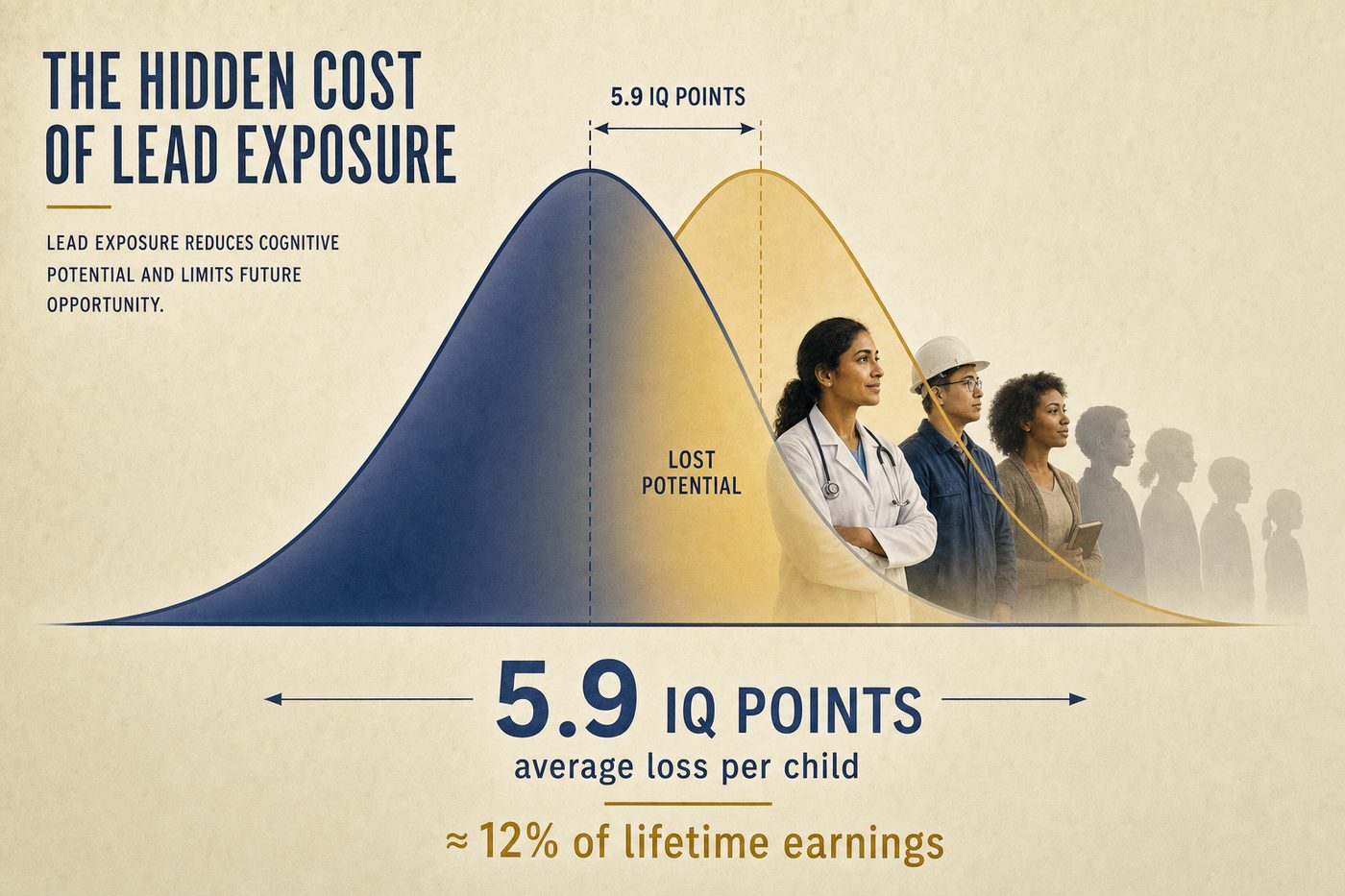
The economic consequences are staggering. That 5.9-point average IQ loss translates to roughly 12% of lifetime earnings per affected child. Across all affected children in low and middle-income countries, the aggregate cost is nearly one trillion dollars per year in lost economic potential (UNICEF/Pure Earth, 2020). For context, total global foreign aid is roughly 200 billion dollars per year. The lead crisis destroys five times more economic value than the entire aid system creates.
Where it comes from
If leaded petrol was banned decades ago, where is the lead coming from?
Informal battery recycling. Used lead-acid batteries are melted down in backyards and small workshops across South Asia, sub-Saharan Africa, and Latin America. The process releases lead dust into surrounding soil and air. Children play in contaminated yards. Families breathe contaminated air. In some regions of Nigeria and Bangladesh, blood lead levels near recycling sites exceed 45 micrograms per decilitre, nine times the danger threshold.
Lead paint. Many low and middle-income countries have not banned lead paint. A 2024 study across 25 countries found lead in consumer products at levels that would be illegal in the US or EU (Scientific Reports, 2024). Children ingest lead paint chips and dust from walls, toys, and furniture.
Contaminated spices and cosmetics. Turmeric in Bangladesh is routinely adulterated with lead chromate to enhance its yellow colour. Traditional cosmetics (kohl, surma) contain lead compounds applied directly to children's skin and eyes. These are not fringe products. They are daily-use items in affected communities.
Legacy contamination. Decades of leaded petrol use left lead in soil near roads worldwide. Industrial sites contaminate groundwater. Mining waste leaches into agricultural land. The lead is already in the environment, waiting to be ingested.
The disease burden
Do Gooder
One good decision a week
The research behind each piece takes hours. Get the next evidence-backed read every Tuesday, in 3 minutes.
Free weekly read. Unsubscribe anytime, no guilt.
The Lancet Planetary Health's 2023 modelling study estimated the global burden of lead exposure at 21.7 million disability-adjusted life years (DALYs) annually. To put that in proportion: malaria causes roughly 46 million DALYs per year, and tuberculosis roughly 35 million. Lead is in the same league as the diseases that dominate global health funding, yet receives a fraction of the attention.
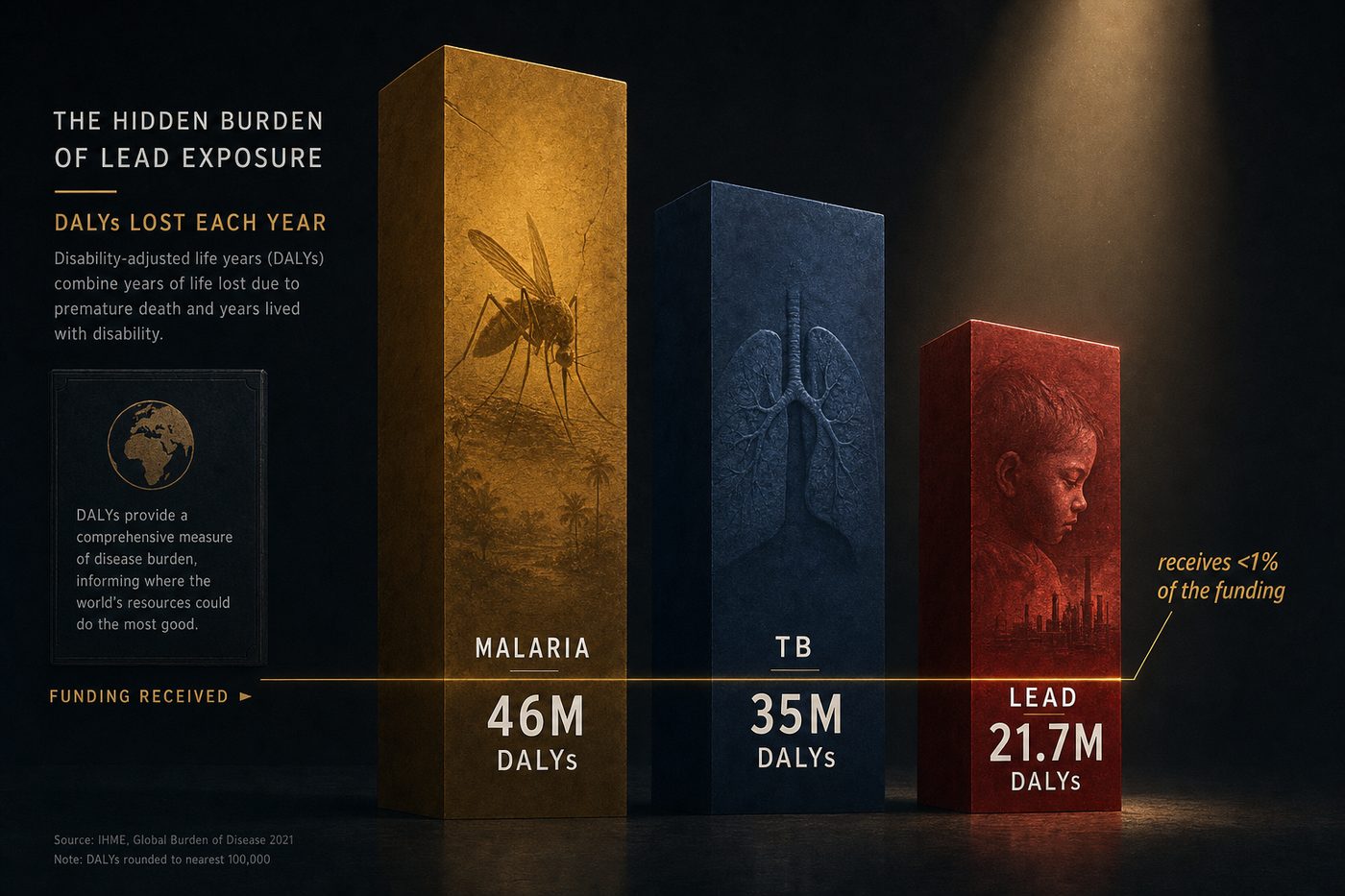
Of those 21.7 million DALYs, 82% come from cardiovascular disease in adults who were exposed as children. The remaining 18% split between mental disorders (12%) and kidney disease (6%). Lead does not just make children less intelligent. It gives them heart disease four decades later.
94% of the burden falls on low and middle-income countries.
Why it is so neglected
Three reasons.
Invisibility. Lead poisoning has no acute symptoms at moderate exposure levels. A child with a blood lead level of 10 micrograms per decilitre, double the danger threshold, looks perfectly healthy. The damage is neurological, gradual, and only visible years later in school performance, earnings data, and cardiovascular outcomes. There is no dramatic photo opportunity, no visible crisis.
Diffuse causation. Malaria has a mosquito. Tuberculosis has a bacterium. Lead poisoning has a hundred sources: paint, batteries, spices, soil, water, cosmetics. There is no single intervention that solves everything, which makes it harder to build a campaign around.
Legacy framing. In wealthy countries, lead is perceived as a solved problem. The Flint water crisis in 2014 briefly revived attention, but the global picture, hundreds of millions of children across dozens of countries, remains invisible to most donors and policymakers.
The cost-effectiveness case
This is where the story turns from bleak to actionable.
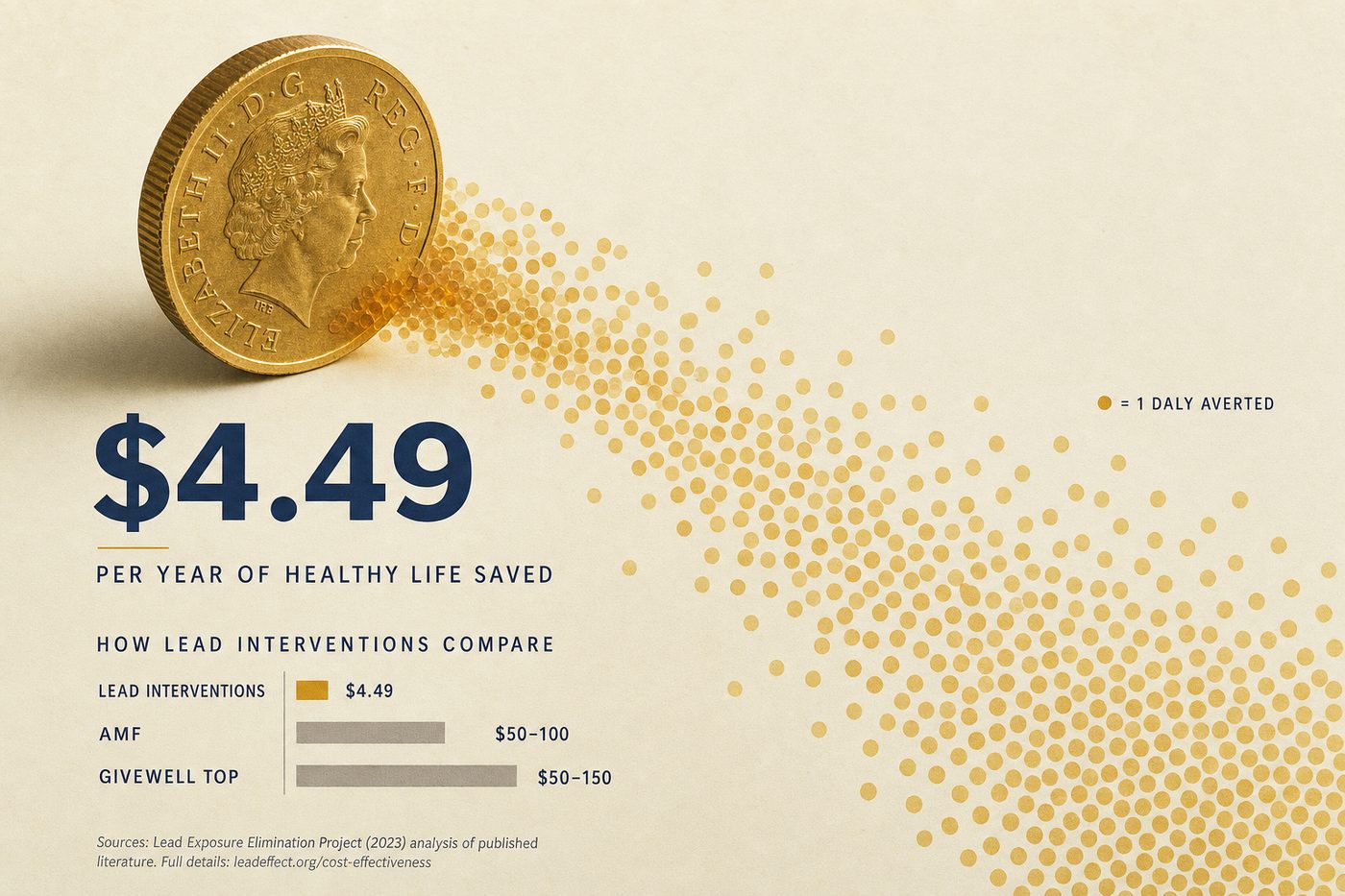
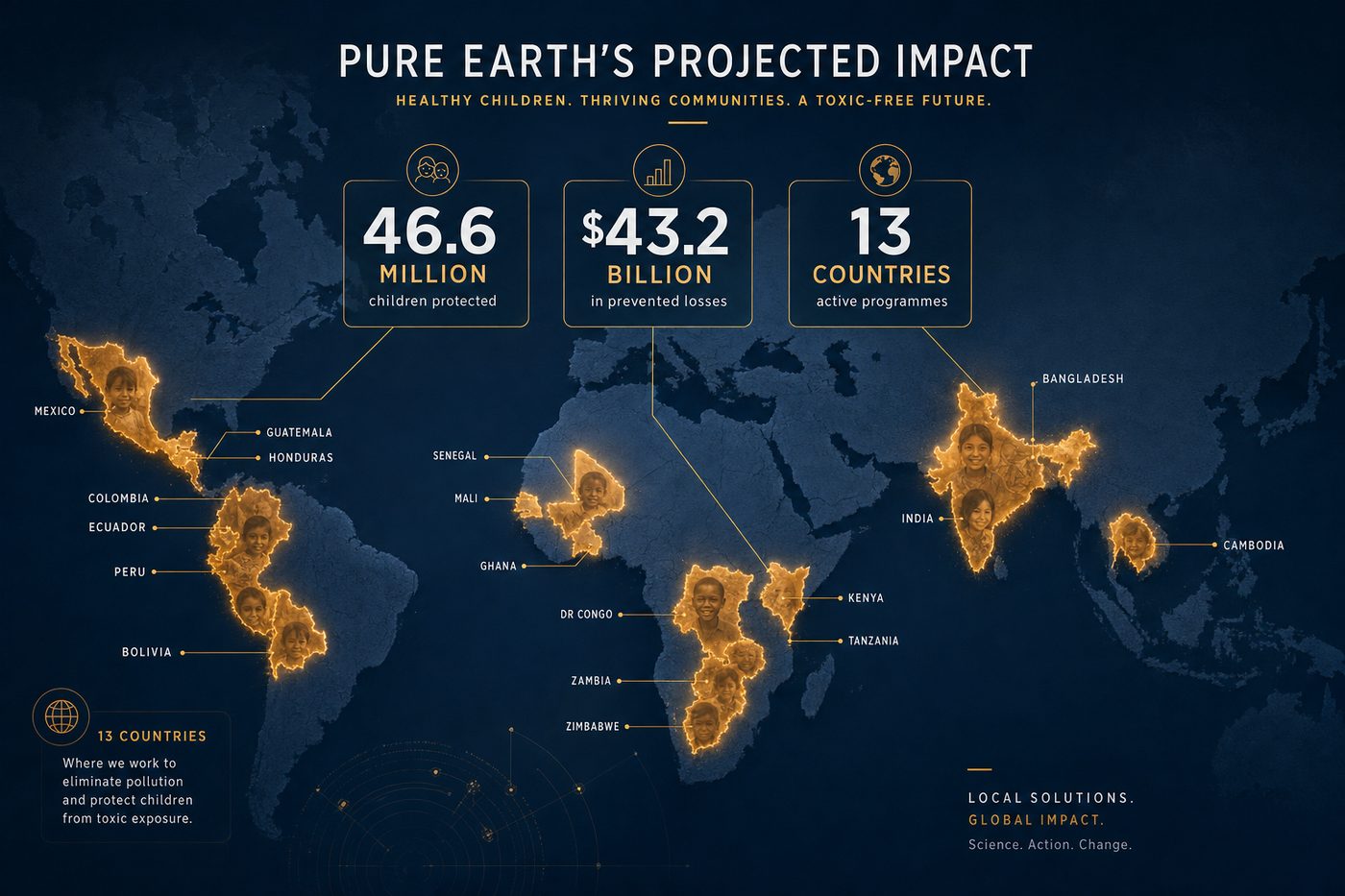
Pure Earth's programmes across 13 countries are estimated to prevent lead exposure in approximately 46.6 million children by 2100, averting an estimated 9.6 million DALYs, with a projected economic benefit of 43.2 billion dollars in prevented earnings losses. The cost per DALY averted is roughly 4.49 dollars (90% confidence interval: 0.78 to 12.93 dollars).
For comparison:
- Against Malaria Foundation: roughly 50 to 100 dollars per DALY averted
- GiveWell top charities: roughly 50 to 150 dollars per DALY averted
- WHO "very cost-effective" threshold: less than GDP per capita per DALY averted
Lead interventions are 10 to 30 times more cost-effective than the charities most effective giving advocates already consider excellent. The numbers are almost embarrassingly good.
The interventions themselves are straightforward: soil remediation at contaminated sites, regulatory support for lead paint bans, safer battery recycling standards, testing and treatment protocols for exposed children, consumer product standards enforcement. None of this is experimental. It is proven environmental health practice, applied in contexts where it has been chronically underfunded.
Where to give
Pure Earth is the primary organisation working on lead exposure in low and middle-income countries at scale. They operate in 13 countries, have partnerships with UNICEF and the World Bank, and publish transparent impact data. GiveWell has investigated lead as a cause area and identified Pure Earth as the leading organisation in the space. Founders Pledge has recommended lead exposure reduction as a high-impact cause area.
Lead Exposure Elimination Project (LEEP) is a newer, smaller organisation focused specifically on lead paint regulation in countries that lack it. Their theory of change is policy-focused: help governments adopt and enforce lead paint standards. The cost per child protected through regulatory change could be extraordinarily low, though the evidence base is still developing.
The Centre for Global Development's lead working group has published a comprehensive framework for prioritising lead interventions. Their analysis supports the cost-effectiveness case and identifies specific high-priority countries.
The opportunity
Lead poisoning is what effective giving looks like when a cause area is genuinely neglected. The interventions work. The evidence is strong. The cost-effectiveness is extraordinary. The funding is almost nonexistent relative to the scale of the problem.
If you are already giving to global health charities and want to diversify into a cause area where your marginal dollar goes absurdly far, lead exposure reduction is the strongest case in effective giving right now. The crisis is invisible, the solution is cheap, and almost nobody is paying for it.
One action
Look up Pure Earth or LEEP. Read their latest impact reports. If the numbers convince you, set up a monthly donation. Even 10 dollars a month, at 4.49 dollars per DALY averted, buys more than two years of healthy life every single month.
Sources used: UNICEF/Pure Earth "The Toxic Truth" (2020), Larsen et al. "Global health burden and cost of lead exposure in children and adults" Lancet Planetary Health (2023), Rethink Priorities Global Lead Exposure Report (2024), Pure Earth Global Lead Program impact data (2024), Lead Exposure Elimination Project annual report (2024), Our World in Data lead poisoning analysis, Scientific Reports rapid market screening across 25 LMICs (2024), Centre for Global Development lead working group framework. Full links in the planning doc.
More in Big Levers