The cage-free revolution
5 May 2026 · 7 min read
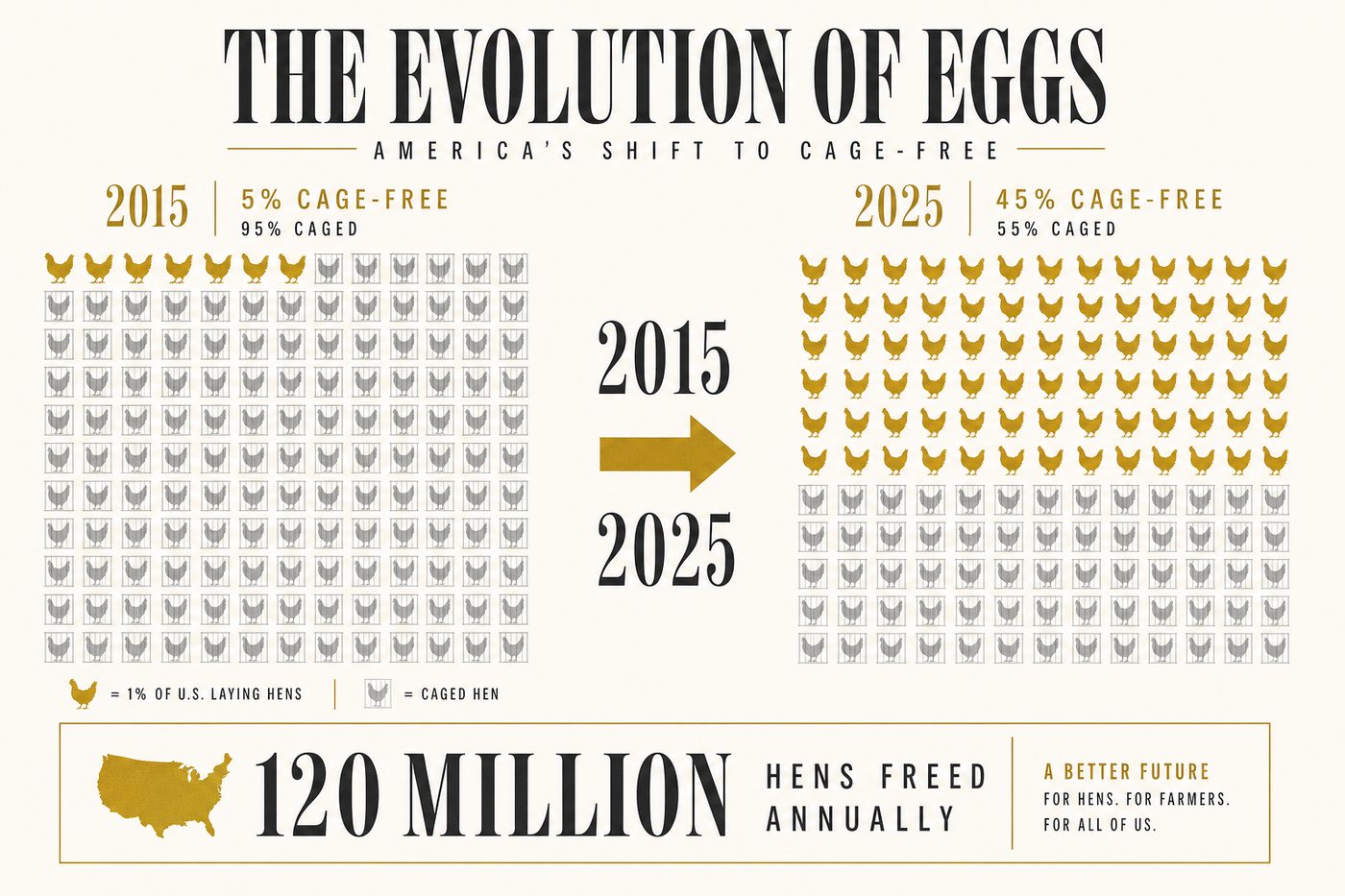
A battery cage gives an egg-laying hen about 67 square inches of space. That's smaller than a sheet of A4 paper. In 2015, only about 13% of the American flock lived outside them.
Ten years later, 45.7% of US hens are cage-free. That's more than 130 million birds, with over 90 million moved out of battery cages in a decade. Consumers didn't drive that shift, and neither did regulators. A handful of charities did it, running targeted corporate campaigns on budgets so small they'd barely register on most nonprofits' balance sheets. The cost works out to something like a dollar per hen. Maybe less.
The mechanics are straightforward. An organisation like The Humane League identifies a major food company, researches its egg supply chain, and contacts it with a request: commit to cage-free eggs by a specific date. If the company ignores them, things escalate. Public campaigns, social media pressure, investor outreach, shareholder resolutions, protests at headquarters. Most companies agree before it gets to that point, because fighting an animal cruelty campaign in public costs more than switching egg suppliers.
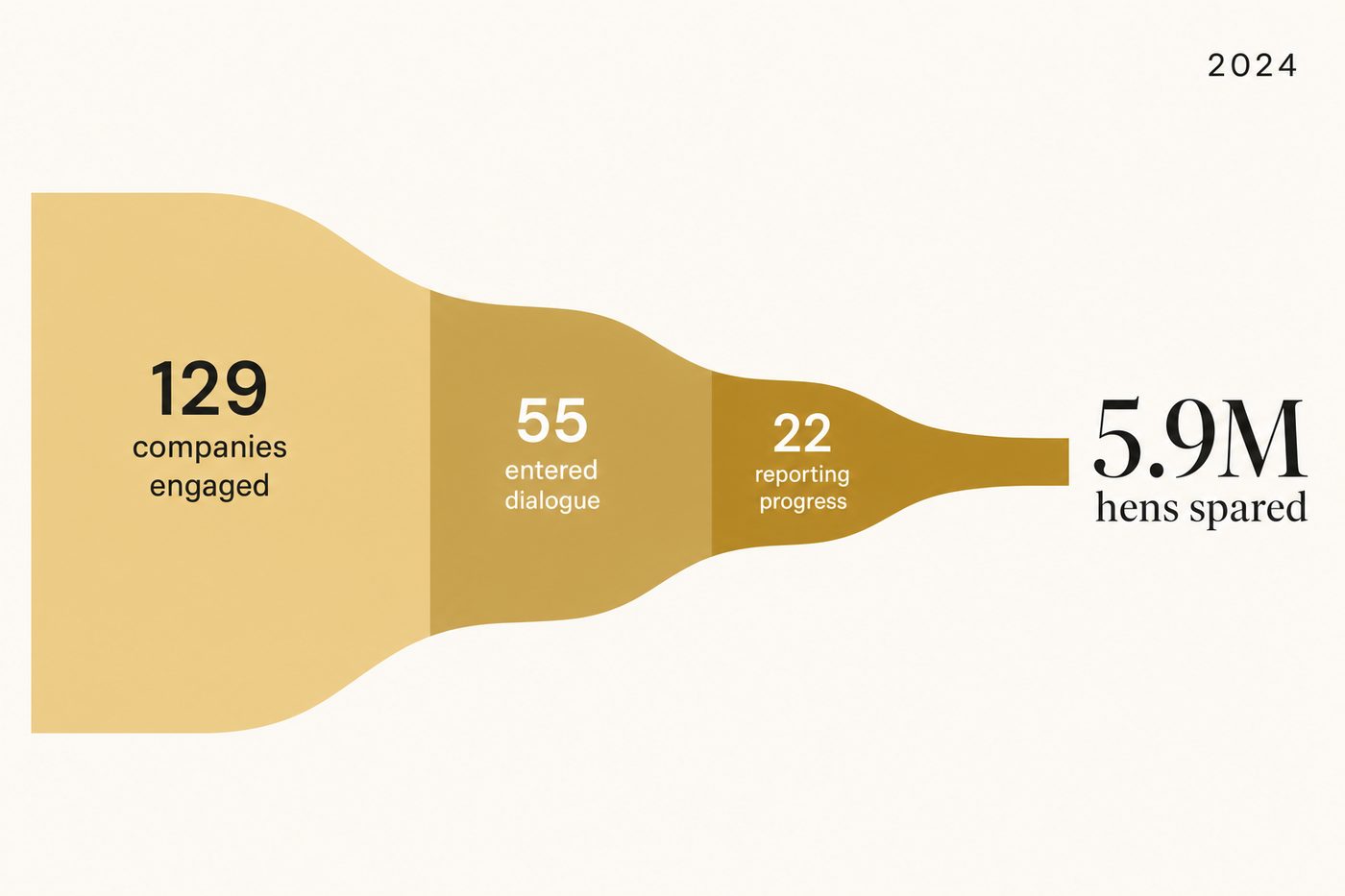
THL now coordinates the Open Wing Alliance, a coalition of over 100 organisations running these campaigns across Latin America, Asia, Africa, and Eastern Europe. In 2024, THL engaged 129 companies. 55 entered dialogue. 22 started reporting progress on existing commitments. The OWA secured 140 new cage-free pledges that year, 72 of them already implemented.
Getting the pledge turns out to be the easy part. The harder problem, the one that makes this whole model work or fail, is enforcement. Companies love making public commitments. They're less keen on following through when the news cycle moves on. So THL and the Open Wing Alliance track every single pledge, monitor deadlines, and go back to companies that fall behind. 92% of global cage-free commitments with 2024 deadlines or earlier are now fulfilled. In just the first three quarters of 2025, THL held 109 companies accountable for commitments covering 145 million hens.
For context, most corporate social responsibility pledges have abysmal follow-through. The difference here seems to be persistence: these organisations don't move on and forget. They come back, year after year, with the same spreadsheet.
What a dollar buys
The estimates on cost-effectiveness vary, but they all land in the same territory.
Rethink Priorities puts it at 9 to 120 years of chicken life improved per dollar. That range is wide because it depends on how much credit you give the campaigners versus broader market trends (would some companies have gone cage-free anyway?) and how you quantify the welfare difference between a cage and a barn. Lewis Bollard at Open Philanthropy estimates 38 to 250 hens spared per dollar, discounting for pledges that would have happened without pressure and for partial implementation failures.
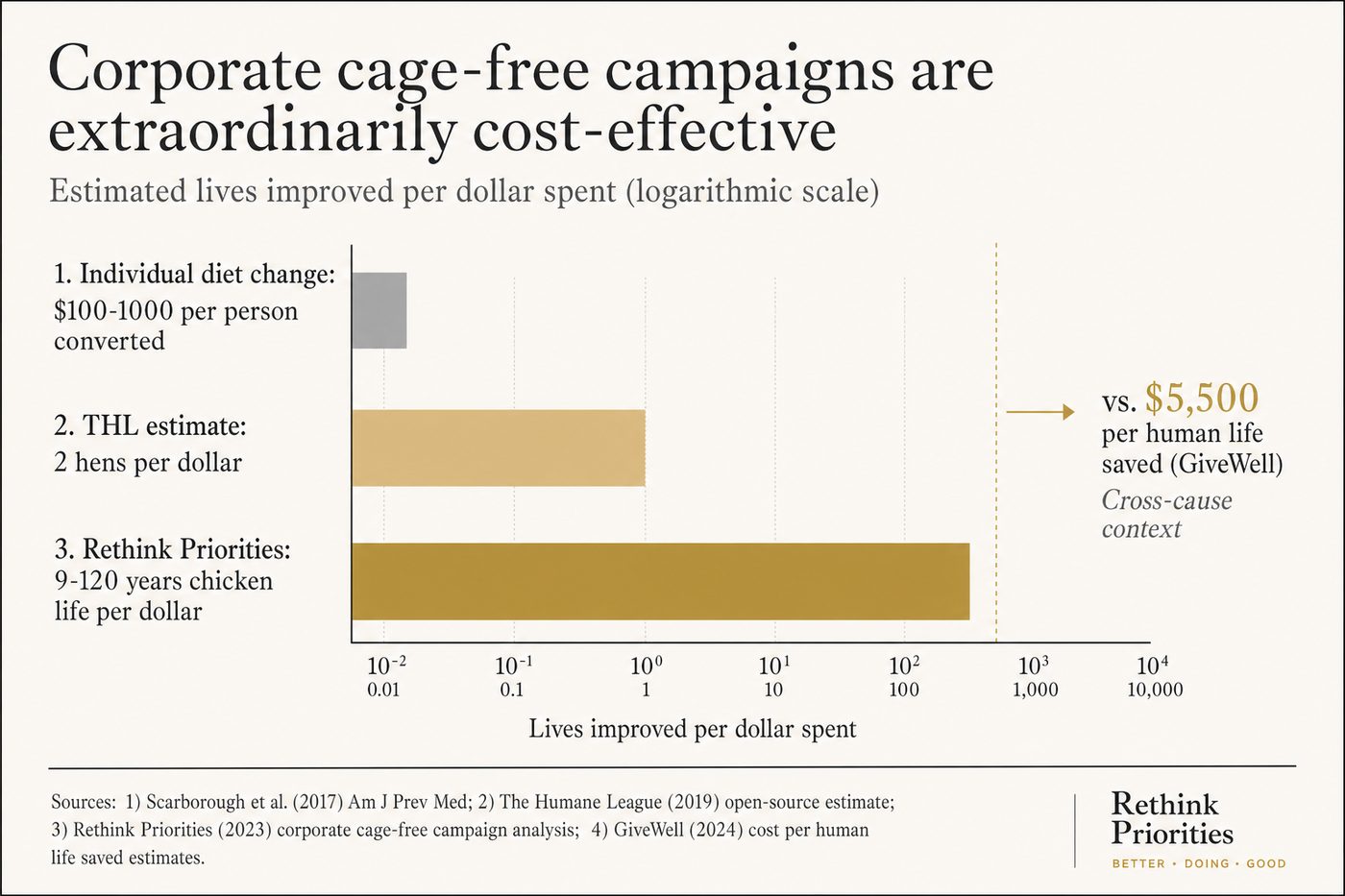
THL's own estimate is more conservative, at about 2 hens per dollar. Sinergia Animal, running similar campaigns in Latin America where costs are lower, gets 53 hens per dollar.
For comparison, convincing an individual person to go vegetarian costs an estimated $100 to $1,000, and the conversion often doesn't stick. Corporate campaigns sidestep individual choice. When McDonald's switches to cage-free eggs, every McMuffin buyer's breakfast changes whether they care about animal welfare or not. You don't need to convince anyone of anything. You change the supply chain and the breakfast follows.
The caveats
Cage-free does not mean good. It means better. A cage-free hen gets about 1 to 1.5 square feet instead of 67 square inches. She can spread her wings. She can walk around a barn. She can't go outside in most systems, and she still gets her beak trimmed. If you've seen footage of cage-free barns, "free" is doing a lot of work in the phrase. This is a welfare floor, and a low one.
Then there's the question that sits underneath all animal welfare work: how much does a hen's experience matter relative to a human's? People in the effective altruism community disagree about this more than almost anything else. If you weight chicken suffering at 1/1000th of human suffering, corporate campaigns still look cost-effective. If you weight it at zero, none of this matters. Most people haven't thought about it carefully enough to have a firm number, and the absence of a firm number tends to default to "not much."
The egg industry isn't taking this lying down, either. Producers have lobbied against state-level cage-free mandates. California's Proposition 12 went all the way to the Supreme Court. That 8% of unfulfilled commitments represents companies that made pledges and then dug in. The campaign model works, but there's friction building.
Why it matters beyond hens
Do Gooder
One good decision a week
The research behind each piece takes hours. Get the next evidence-backed read every Tuesday, in 3 minutes.
Free weekly read. Unsubscribe anytime, no guilt.
Even if you don't care about chickens, the mechanics here transfer. The same corporate pressure approach now applies to broiler welfare (slower-growing breeds, lower stocking densities), fish welfare, and dairy. THL's 2025 funding case identifies broiler chickens as the next front: 9 billion killed per year in the US alone, often in conditions worse than battery cages.
The broader pattern is about where pressure gets applied. One campaign against a single food company changes the supply chain for millions of animals. You don't need to persuade millions of consumers to change their behaviour. You persuade one executive, or pressure one board, and the rest follows. It's the same logic behind why climate policy advocacy tends to outperform individual carbon offsetting: change the rules and individual decisions stop mattering.
The other thing that makes cage-free campaigns unusual is how measurable they are. Companies make public commitments with dates. The dates arrive. Either the eggs are cage-free or they aren't. You can count hens. You can track dollars spent. Most charitable advocacy is hard to evaluate because causation is murky, but this one has clean data. Animal Charity Evaluators recommends THL as a top charity, and the numbers hold up to scrutiny.
If you eat eggs, it's worth checking whether your supplier has a cage-free commitment with a deadline attached. If they don't, saying something adds one more voice to the pressure that makes the next campaign a little easier to run.
Sources
- Corporate campaigns affect 9 to 120 years of chicken life per dollar spent (Rethink Priorities), accessed June 2026
- The Tipping Point: 45.7% of US Hens Are Now Free from Cages (The Humane League), accessed June 2026
- Global Cage-Free Egg Fulfillment Rate Jumps to 92% (The Humane League), accessed June 2026
- 2024 Annual Report, 129 companies engaged, 55 in dialogue, OWA 140 new commitments (The Humane League), accessed June 2026
- Initial Grants to Support Corporate Cage-free Reforms, 38 to 250 hens per dollar (Open Philanthropy), accessed June 2026
- The Humane League Review, 2025 Recommended Charity (Animal Charity Evaluators), accessed June 2026
More in Bright Spots