The overhead myth
30 April 2026 · 7 min read
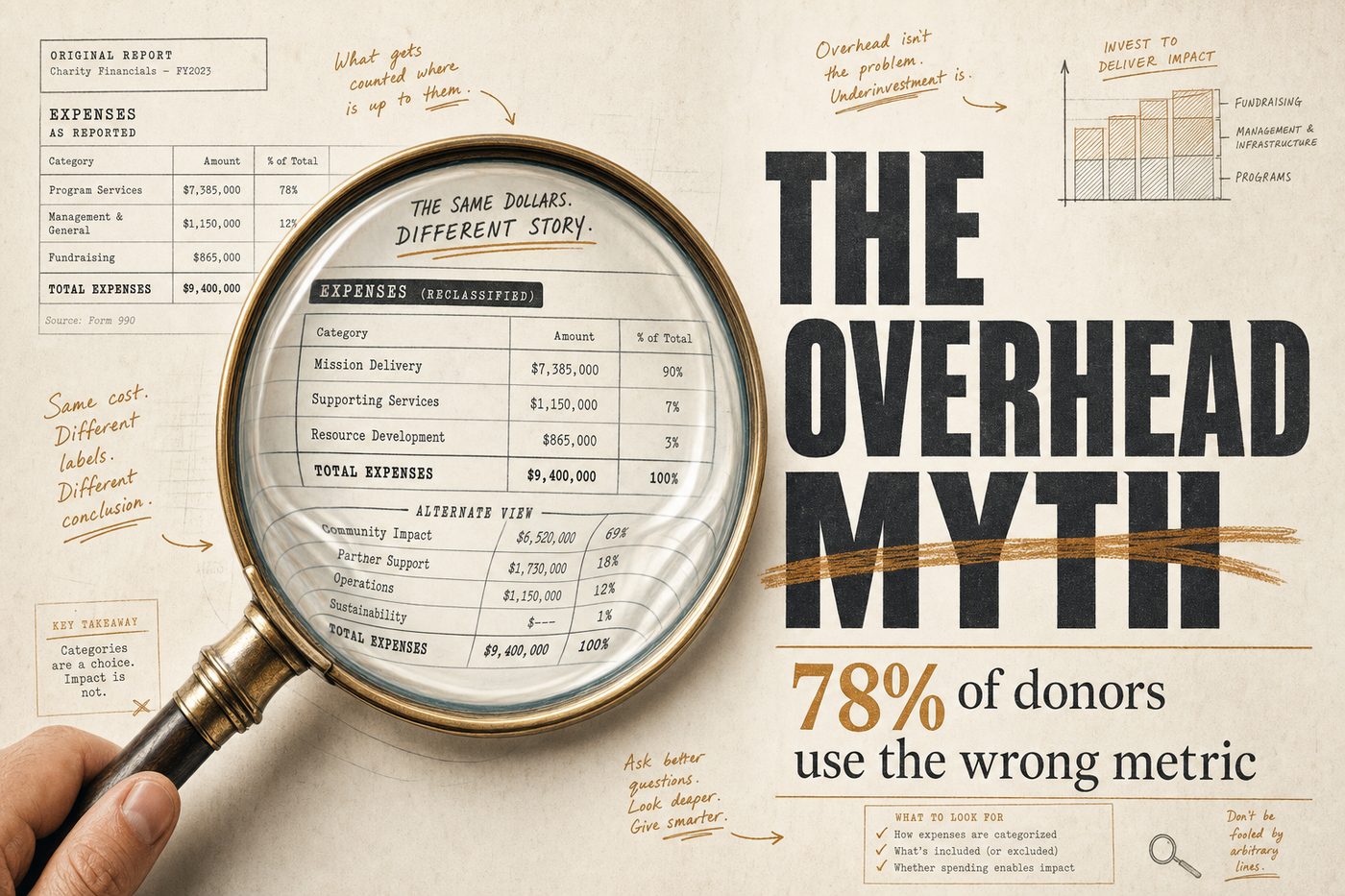
The most common question donors ask about a charity is: "What percentage goes to the cause?" It sounds reasonable. You want your money helping people, not funding office furniture. The problem: this question has almost zero predictive power for whether a charity actually achieves anything. And the obsession with it has actively damaged the sector.
The overhead myth is the belief that a charity's administrative and fundraising costs are inversely related to its effectiveness. Low overhead equals good charity. High overhead equals wasteful charity. It's intuitive, widely held, and wrong.
Where the myth comes from
Charity watchdogs built it. Charity Navigator, the largest US charity rating platform, originally rated organisations almost entirely on financial ratios: overhead percentage, fundraising efficiency, CEO compensation relative to budget. For over a decade, their star ratings were essentially a purity test on how little charities spent on themselves. The BBB Wise Giving Alliance set a benchmark of 35% maximum overhead. The UK's equivalent, the Charity Commission, publishes spending breakdowns that implicitly encourage donors to compare ratios.
Media amplifies it. Every few years, a newspaper runs an investigation into charities with "shocking" overhead rates. The framing is always the same: donors outraged, CEO overpaid, money wasted. The implicit message: a good charity should run on volunteer labour and donated paperclips.
Donors internalised it. The Money for Good study (2015, Camber Collective for the Gates Foundation) found that 78% of donors said overhead ratio was important or very important when choosing charities. Only 35% said they looked at impact evidence. Donors optimise for the wrong metric because the sector taught them to.
Why it's wrong
Three reasons the overhead ratio fails as a quality signal.
Accounting is arbitrary. What counts as "programme" versus "administration" is a classification decision, not a fact. A charity that sends a programme manager to supervise field operations can classify their salary as programme cost. A charity that has a finance officer ensure grants reach the right beneficiaries must classify them as admin. The Centre for Effective Philanthropy (2024) found that the same activity can be classified differently across organisations, making ratio comparisons meaningless. Charities face pressure to reclassify administrative costs as programme costs, creating a race to the bottom in honest reporting.
Low overhead can signal underinvestment. An organisation that spends nothing on monitoring and evaluation has low overhead. It also has no idea whether its programmes work. An organisation that spends nothing on staff training has low overhead. It also burns through employees and loses institutional knowledge. An organisation that spends nothing on fundraising has low overhead. It also can't grow, even if its programmes are highly effective. Dan Pallotta's TED talk "The Way We Think About Charity Is Dead Wrong" (2013, 4.8 million views) made this argument accessible: we penalise charities for investing in the very things that would make them more effective.
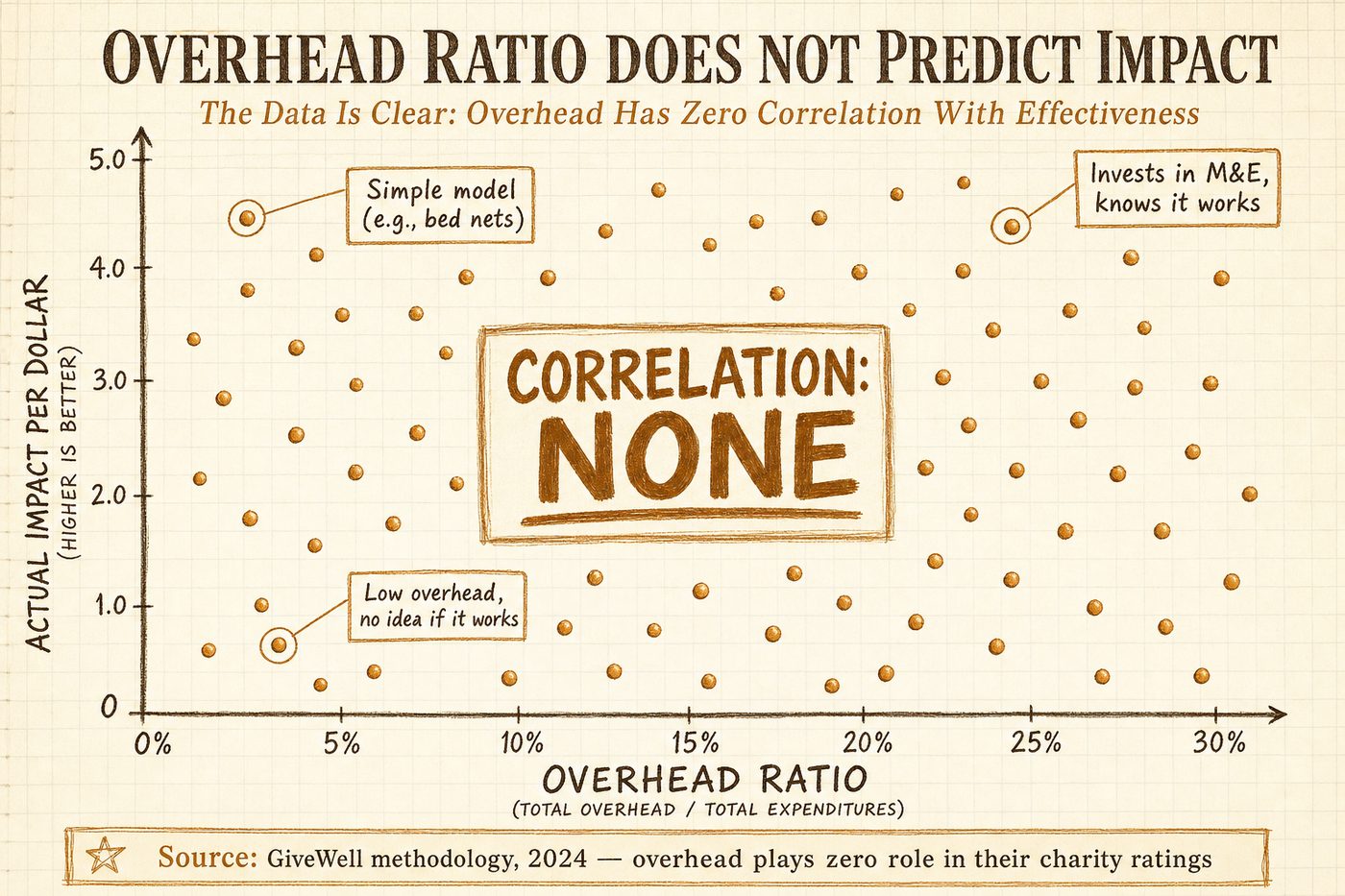
High overhead can signal effectiveness. GiveWell's top charities have varying overhead rates, and GiveWell explicitly ignores overhead in their analysis. The Against Malaria Foundation has notably low overhead (roughly 3-5%) because their model is simple: buy nets, ship nets. Malaria Consortium has higher overhead (roughly 15-20%) because they coordinate with government health systems, train community health workers, and run complex logistics. Both are among the most cost-effective charities in the world. The overhead difference reflects operational model, not quality.
What the evidence says
Do Gooder
One good decision a week
The research behind each piece takes hours. Get the next evidence-backed read every Tuesday, in 3 minutes.
Free weekly read. Unsubscribe anytime, no guilt.
The Stanford study. Gneezy, Keenan and Gneezy (2014, Science) ran an experiment with real donations. When donors were told a charity had zero overhead (a separate donor covered all admin costs), they gave significantly more. But the researchers found no relationship between a charity's overhead ratio and its actual effectiveness. Donors were responding to a psychological signal, not a quality signal.
GiveWell's analysis. GiveWell has explicitly stated that overhead ratios play no role in their charity recommendations. Their 2024 methodology document notes: "We have not found overhead rates to be a useful predictor of cost-effectiveness. We focus exclusively on the cost per unit of impact achieved, regardless of how costs are categorised." Their top charity list includes organisations with overhead ranging from 3% to 25%.
The Open Road Alliance data. The Open Road Alliance (2023) studied 300+ nonprofit projects that hit implementation roadblocks. The most common causes of project failure were underfunding of operations, insufficient monitoring, and inadequate staffing. In other words: the problems caused by low overhead. Projects with adequate operational funding were significantly more likely to achieve their stated goals.
The Charity Navigator pivot
In 2021, Charity Navigator announced they were moving away from financial ratio-based ratings toward an "Encompass Rating System" that includes impact evidence, accountability, and leadership quality alongside finances. The change took over a decade of advocacy from the effective giving community.
Their CEO at the time acknowledged: "We recognise that our historical emphasis on financial metrics alone has been an incomplete picture of charity performance." The new system still includes financial health (because solvency matters), but no longer treats overhead as the primary signal of quality.
The UK equivalent, the Charity Commission, has been slower to shift. Their annual return data still prominently features spending breakdowns, and media coverage still uses these figures to generate outrage stories. But the Charities Aid Foundation and New Philanthropy Capital have both published guidance discouraging donors from overhead-based decision-making.
What actually predicts impact
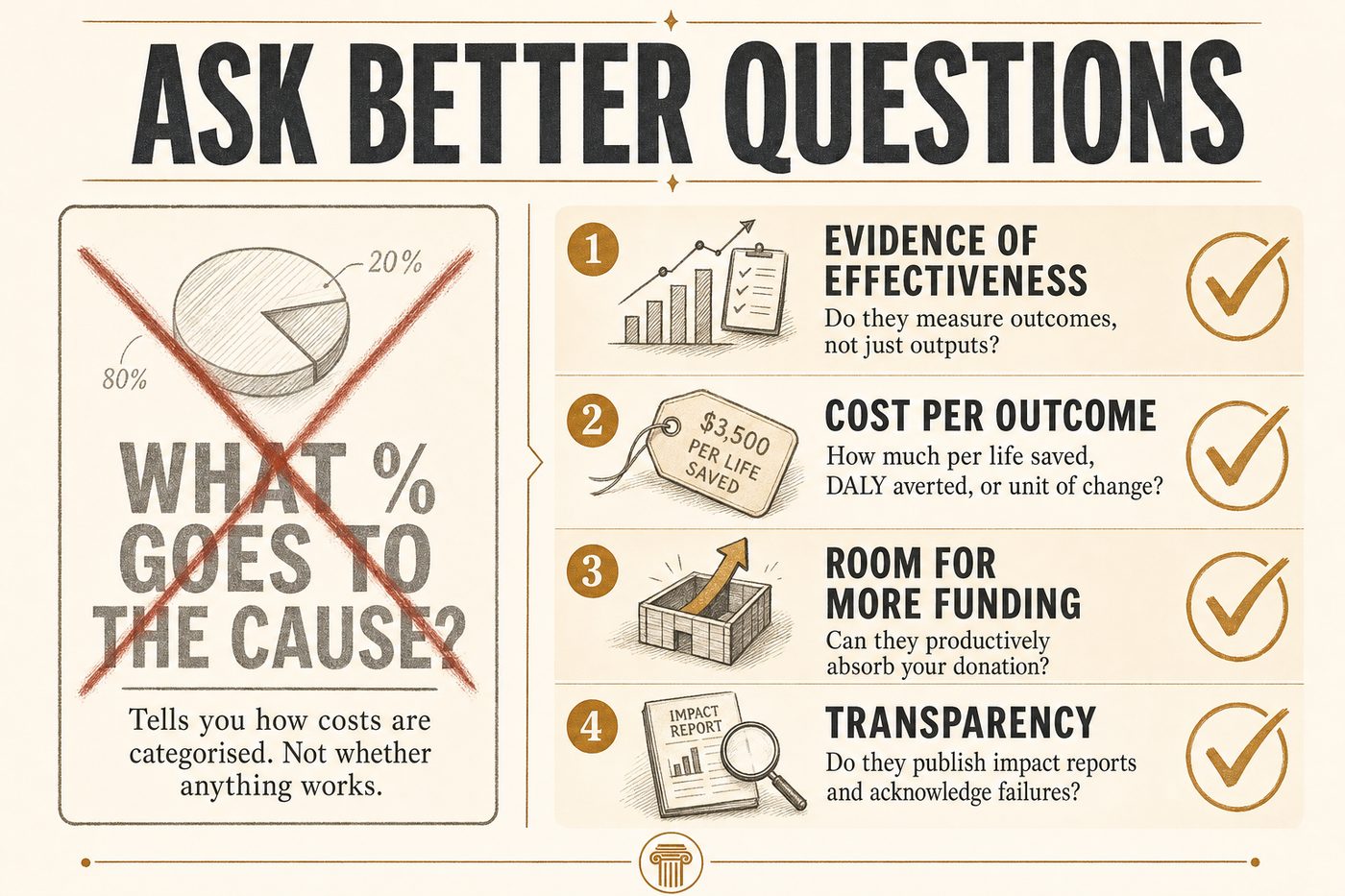
If overhead doesn't predict quality, what does? Four better signals.
Evidence of effectiveness. Does the charity measure outcomes, not just outputs? "We distributed 10,000 leaflets" is an output. "Vaccination rates increased by 17 percentage points in our operating area" is an outcome. Charities that measure outcomes invest in monitoring and evaluation, which shows up as higher overhead. The irony is complete.
Cost per outcome. How much does it cost to achieve one unit of the desired result? GiveWell's cost-per-DALY-averted framework, the cash benchmark (does this beat just giving money directly?), and quasi-experimental evidence all provide better signal than overhead ratios. See our articles on the cash benchmark and cost per outcome for more.
Room for more funding. Can the charity productively absorb additional donations, or will marginal dollars pile up in reserves? This is a signal of organisational capacity and strategic planning. A charity with clear expansion plans and the operational infrastructure to execute them is likely well-managed, regardless of overhead rate.
Transparency and accountability. Does the charity publish detailed impact reports? Do they acknowledge failures? Do they explain how they allocate resources and why? Transparency about spending decisions is more informative than the spending ratios themselves.
The damage done
The overhead myth hasn't just misled donors. It's actively harmed the charities trying to do good work.
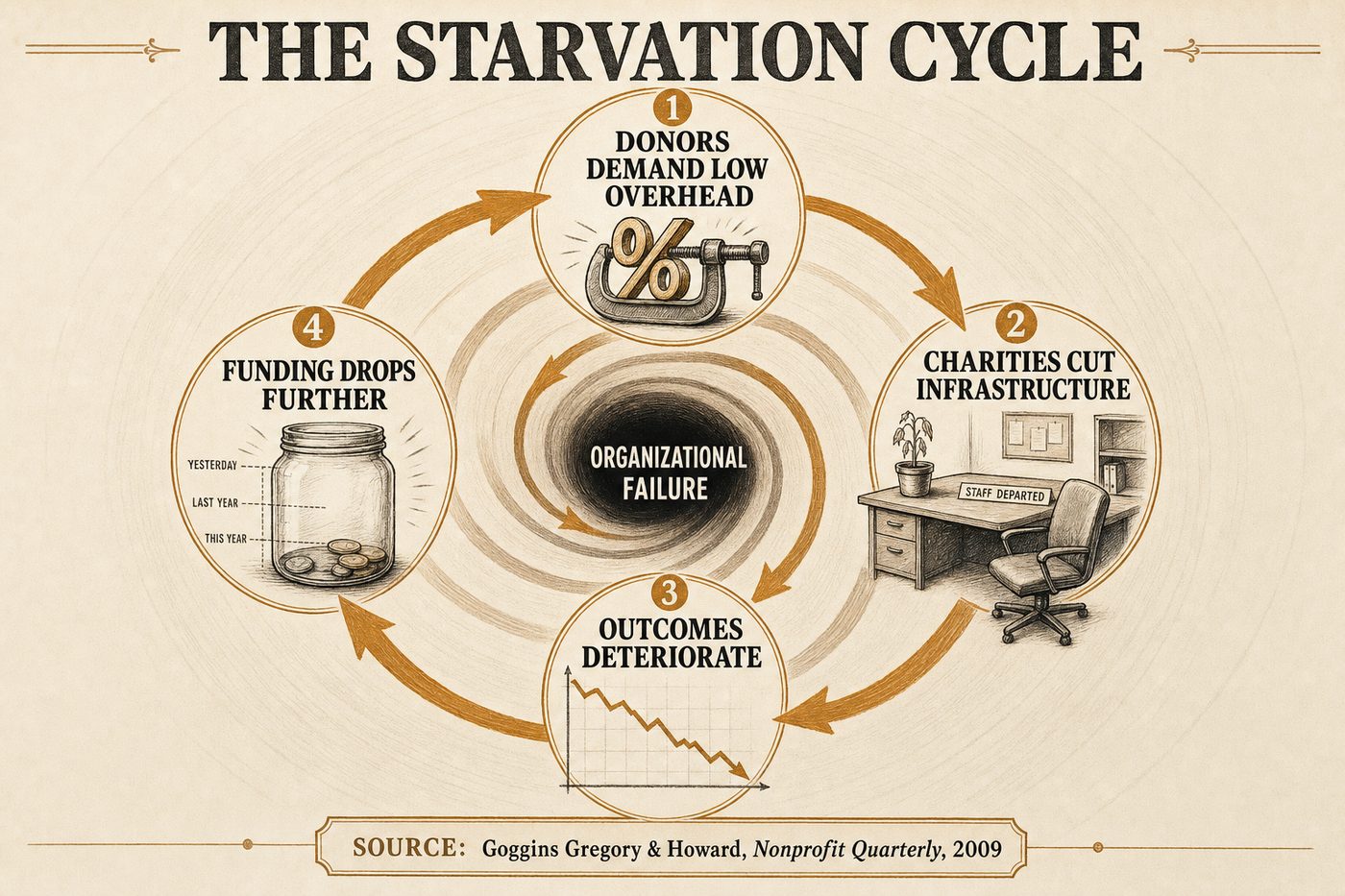
The starvation cycle. A term coined by the Nonprofit Quarterly (Goggins Gregory and Howard, 2009): donors demand low overhead, so charities underinvest in infrastructure. Underinvestment leads to worse outcomes. Worse outcomes lead to less funding. Less funding means more pressure to cut overhead. The cycle grinds organisations down.
Talent drain. If charities can't pay competitive salaries (because that would increase overhead), they lose talented people to the private sector. The people most capable of running effective programmes leave for organisations that pay them fairly. The sector retains those willing to accept below-market compensation, which is a mix of genuine altruists and people who can't get better offers elsewhere.
Innovation suppression. Testing new approaches requires R&D spending. R&D spending is overhead. So charities stick with established (possibly ineffective) programmes rather than investing in finding better approaches. The sector optimises for looking lean rather than being effective.
For your giving
Stop asking about overhead. It tells you almost nothing useful. Instead ask: what evidence does this charity have that their programmes work? How do they measure success? What does a dollar buy in terms of actual outcomes?
Look for GiveWell or ACE recommendations. These organisations do the hard work of cost-effectiveness analysis so you don't have to. Their recommendations account for all costs (including overhead) in calculating impact per dollar.
Accept that good organisations need infrastructure. A charity that spends 20% on admin but achieves 10x the impact per dollar is obviously better than a charity that spends 5% on admin and achieves nothing measurable. The ratio is irrelevant. The outcome is everything.
Be suspicious of zero-overhead claims. When a charity claims 100% of your donation goes to the cause, ask who's paying for the accountant, the website, the staff, the monitoring. Either someone else is subsidising those costs (which is fine but means the claim is misleading), or they're genuinely not investing in operational capacity (which means they probably don't know if they're effective).
One sentence
The overhead ratio tells you how a charity categorises its spending, not whether it achieves anything. Ask about impact per dollar instead, and accept that effective organisations need to invest in the infrastructure that makes them effective.
Sources used: Gneezy, Keenan and Gneezy "Avoiding Overhead Aversion in Charity" (Science, 2014), Money for Good donor survey (Camber Collective/Gates Foundation, 2015), Pallotta "The Way We Think About Charity Is Dead Wrong" (TED, 2013), Charity Navigator Encompass Rating System announcement (2021), Open Road Alliance implementation data (2023), GiveWell cost-effectiveness methodology and overhead position statement (2024), Centre for Effective Philanthropy accounting classification analysis (2024), Goggins Gregory and Howard "The Nonprofit Starvation Cycle" (Nonprofit Quarterly, 2009), CAF UK giving guidance on overhead metrics (2024). Full links in the planning doc.
More in The Receipts