The neglected tropical diseases
1 May 2026 · 7 min read
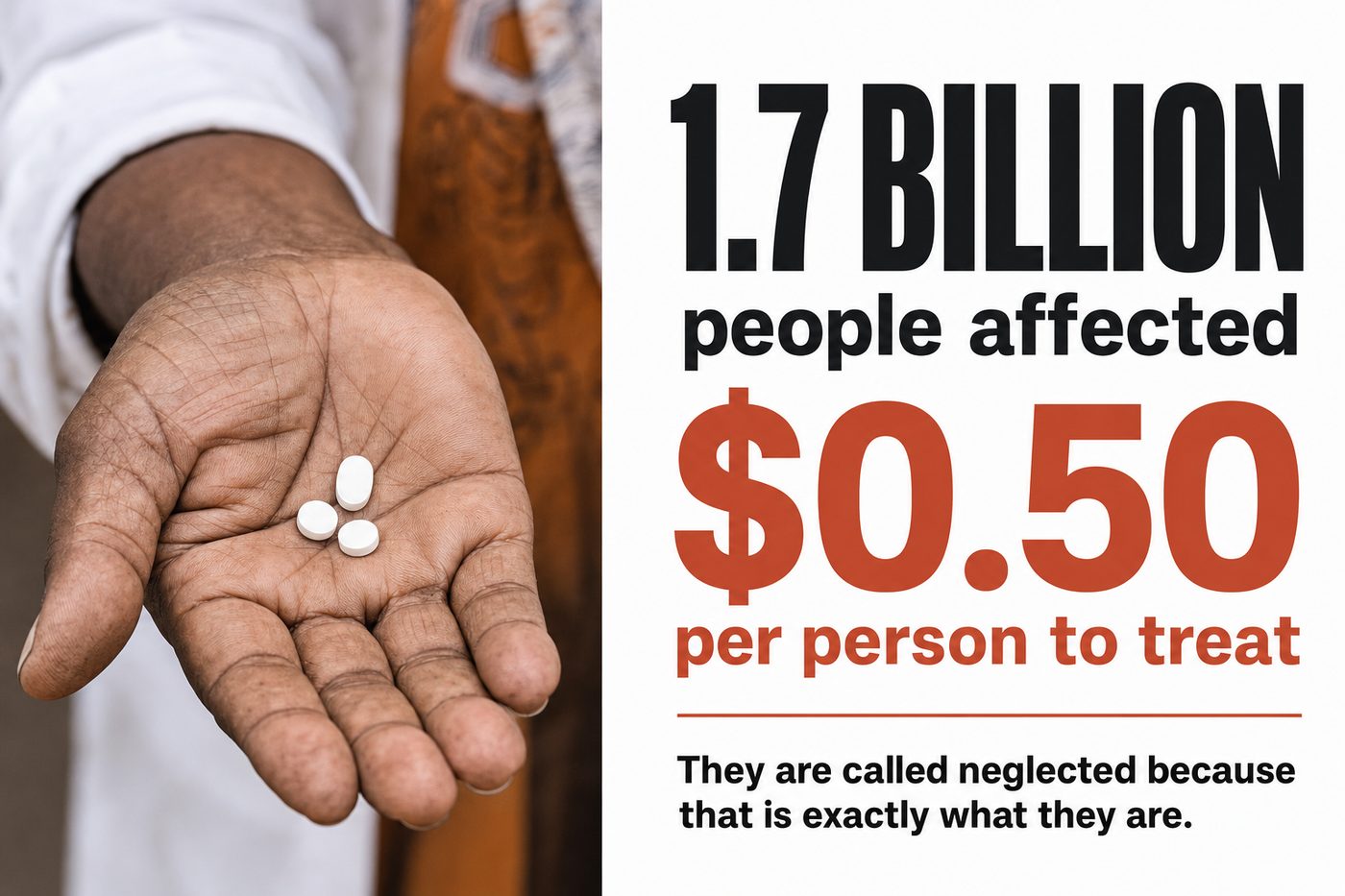
There are twenty diseases that the World Health Organisation classifies as "neglected tropical diseases." They blind, disfigure, disable, and kill. They affect 1.7 billion people, almost entirely in the poorest countries on earth. And they're called "neglected" because that's exactly what they are: neglected by pharmaceutical companies (no profit), neglected by donors (no glamour), and neglected by governments (no political constituency).
The cruelest part: most of them are cheap to treat. Mass drug administration for intestinal worms costs roughly $0.50 per person per year. Treatment for schistosomiasis: roughly $0.20 per tablet. Lymphatic filariasis elimination through community drug distribution: roughly $0.05 per person treated. These are not unsolved medical problems. They're unsolved funding problems.
What NTDs actually are
The WHO's NTD list includes diseases you've probably never heard of: schistosomiasis, lymphatic filariasis, onchocerciasis, soil-transmitted helminths (hookworm, roundworm, whipworm), trachoma, Chagas disease, leishmaniasis, and others. They share common features.
Poverty diseases. NTDs disproportionately affect people living on less than $2 per day. They thrive in conditions of poor sanitation, contaminated water, and crowded housing. Unlike HIV/AIDS or tuberculosis, which affect people across income levels, NTDs are almost exclusively diseases of the poorest.
Chronic not dramatic. Most NTDs don't kill quickly. They disable slowly. Intestinal worms reduce nutrient absorption, stunting children's physical and cognitive development. Trachoma causes progressive scarring of the eyelid, eventually turning the eyelashes inward until they scratch the cornea and cause blindness. Lymphatic filariasis causes grotesque swelling of limbs and genitals (elephantiasis). The suffering is immense but undramatic, which is exactly why donors and media ignore it.
Preventable and treatable. Unlike many diseases where we're still searching for effective interventions, NTD treatments exist, work well, and are extraordinarily cheap. The pharmaceutical companies Merck, GSK, Johnson & Johnson, and Pfizer donate billions of treatment doses annually through the WHO. The constraint isn't medicine. It's the logistics of getting it to 1.7 billion people.
The funding scandal
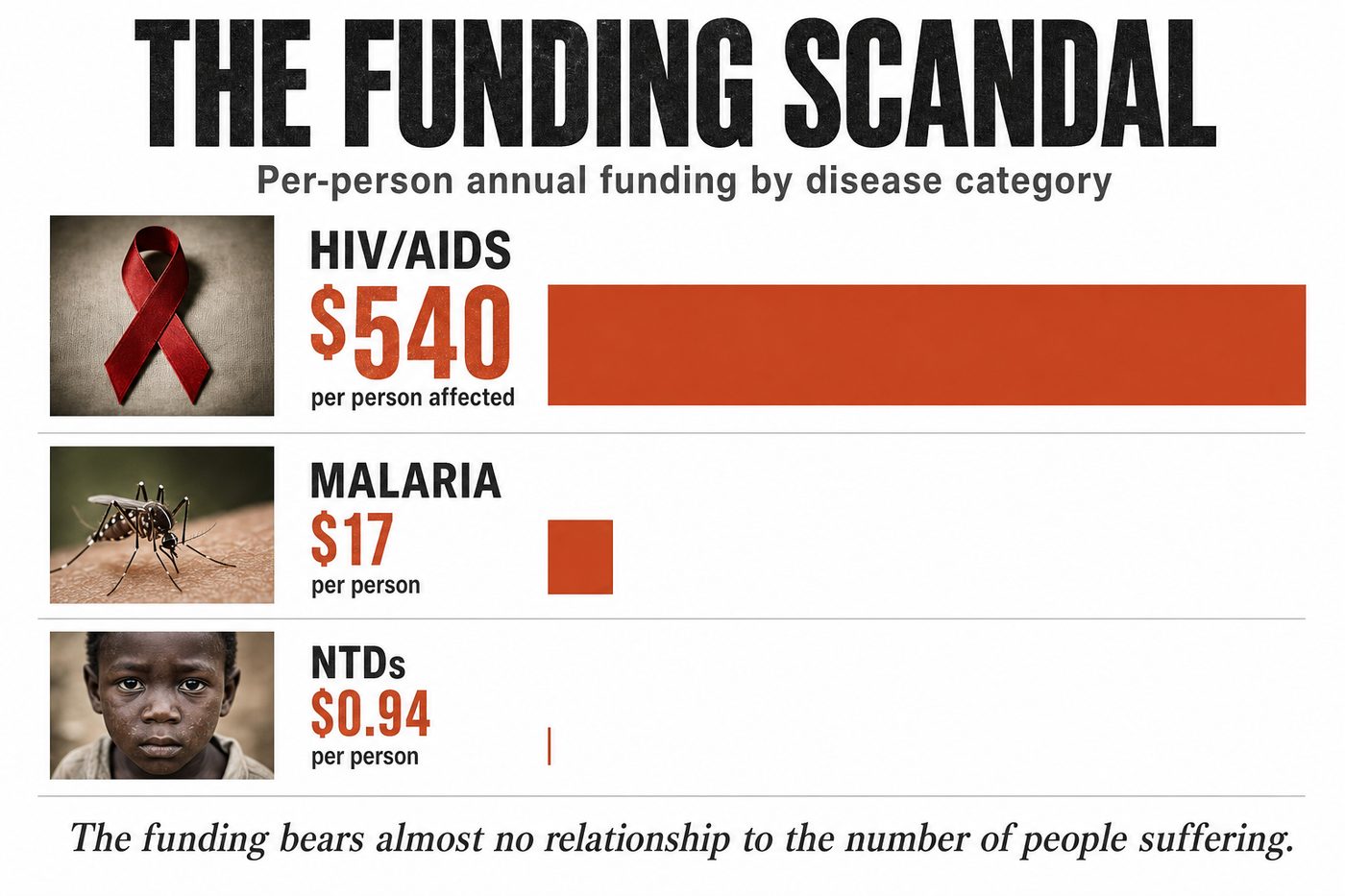
The comparison. HIV/AIDS had roughly $19.8 billion available in global funding in 2023 (UNAIDS, 2024). It affects roughly 39 million people. Malaria control drew roughly $4 billion in total investment in 2023 (WHO World Malaria Report, 2024). It affects roughly 250 million people annually. Neglected tropical diseases collectively receive a small fraction of that despite affecting far more people. They require treatment for around 1.7 billion people.
Per-person funding: HIV/AIDS gets several hundred dollars per person affected. Malaria gets roughly $16. NTDs get well under a dollar. The funding bears almost no relationship to the number of people suffering.
Why the gap exists. Three factors compound. First, NTDs lack a powerful advocacy movement (compare to the HIV/AIDS activism of ACT UP and the Global Fund). Second, NTDs affect people with no political power: rural poor in sub-Saharan Africa, South Asia, and Latin America. Third, NTDs are a collection of 20 different diseases, which fragments advocacy. "End NTDs" is harder to rally around than "End AIDS."
The mass drug administration model
Do Gooder
One good decision a week
The research behind each piece takes hours. Get the next evidence-backed read every Tuesday, in 3 minutes.
Free weekly read. Unsubscribe anytime, no guilt.
The most cost-effective NTD intervention is mass drug administration (MDA): treating entire at-risk communities preventively, regardless of whether individuals show symptoms.
How it works. Community health workers distribute donated medications to everyone in a target area. For soil-transmitted helminths (worms), this typically means a single albendazole or mebendazole tablet, given annually or biannually. For schistosomiasis, it's praziquantel. For lymphatic filariasis, it's a combination of ivermectin, albendazole, and/or DEC. The drugs are donated by pharmaceutical companies. The cost is almost entirely delivery: training health workers, transport, supervision, monitoring.
The cost-effectiveness. Evidence Action's Deworm the World programme, one of GiveWell's top-recommended charities, delivers school-based deworming at roughly $0.50-1.00 per child treated per year. The SCI Foundation (now part of the END Fund) delivers schistosomiasis treatment at roughly $0.50-1.50 per person treated. These are among the most cost-effective health interventions ever measured.
The evidence debate. Deworming's evidence base is contested. The original Miguel and Kremer study (2004, Econometrica) found that mass school-based deworming cut absenteeism by roughly a quarter, including in untreated neighbouring schools, though it found no effect on test scores. A later follow-up (Baird et al., "Worms at Work," 2016) found long-run earnings gains. A Cochrane review (Taylor-Robinson et al., updated 2019) found little or no effect on weight, haemoglobin, cognition, or school attendance. GiveWell's position: the Cochrane review focuses on within-community effects, while the original study captured cross-community spillovers (treating one child reduces transmission to others). GiveWell weights both sources and still rates deworming as highly cost-effective, partly because even modest health benefits at $0.50 per child are efficient.
What the effective giving community recommends
Evidence Action's Deworm the World. A GiveWell top charity from 2013 to 2022, and still funded by GiveWell through its All Grants Fund after a change in GiveWell's top-charity criteria. Provides technical assistance to governments running school-based deworming programmes. In 2022 it helped treat roughly 250 million children across India, Kenya, Nigeria, and Pakistan. GiveWell estimates the cost at around $0.50 per child treated.
The END Fund. Focuses on schistosomiasis and soil-transmitted helminths through government MDA programmes across dozens of countries. (The former SCI Foundation, a separate schistosomiasis charity, rebranded to Unlimit Health in 2023; it did not merge into the END Fund.) GiveWell has directed significant funding to NTD programmes in this space.
Sightsavers. Focused on trachoma elimination and river blindness prevention. Sightsavers has helped eliminate trachoma as a public health problem in multiple countries through the SAFE strategy (Surgery, Antibiotics, Facial cleanliness, Environmental improvement). Their cost per trachoma surgery restoring sight: roughly $50-100.
The elimination opportunity
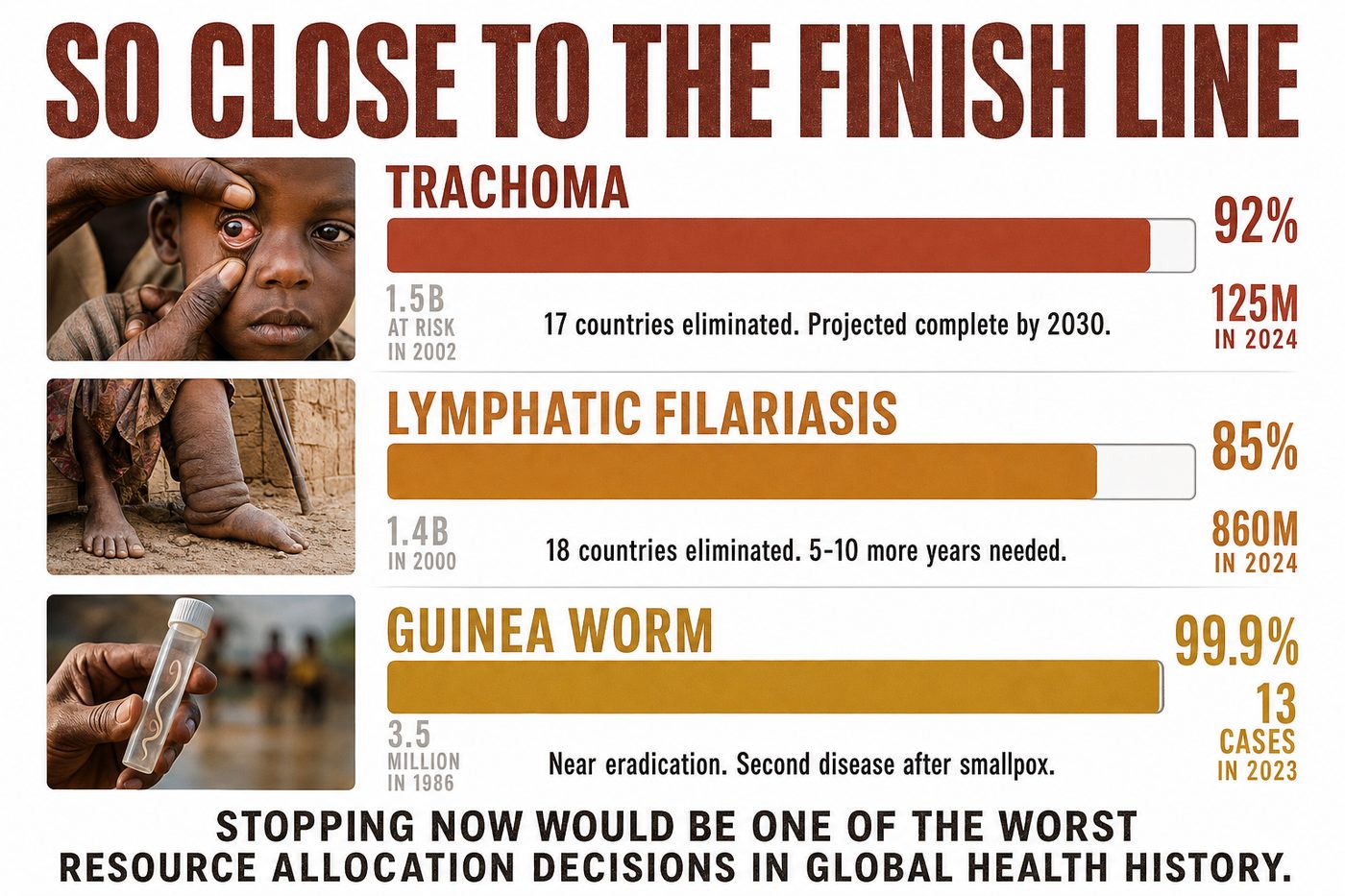
Unlike many global health problems, several NTDs are on the verge of elimination.
Trachoma. The number of people at risk has dropped from roughly 1.5 billion in 2002 to about 97 million as of late 2025 (WHO). By early 2026, 28 countries had been validated as having eliminated trachoma as a public health problem. Global elimination is targeted for 2030 if funding holds.
Lymphatic filariasis. As of 2024, 21 countries and territories had eliminated LF as a public health problem through sustained MDA. Roughly 657 million people across 39 countries still require preventive chemotherapy (WHO), down sharply over the past two decades. The remaining countries need further rounds of treatment to finish.
Guinea worm. Down to 14 human cases in 2023, from an estimated 3.5 million across 21 countries in 1986. On track to be the second human disease eradicated after smallpox. The Carter Center has led this effort since 1986.
These aren't aspirational targets. They're near-completion projects that need funding to cross the finish line. Stopping now, when victory is close, would be one of the worst resource allocation decisions in global health history.
For your giving
NTD charities offer a compelling proposition: extremely low cost per person treated, donated medicines, government partnership for sustainability, and measurable progress toward elimination.
If you want maximum cost-effectiveness per person reached: Evidence Action's Deworm the World treats children for around $0.50 each. Few health interventions reach more people per dollar.
If you want to fund elimination: Sightsavers for trachoma, or the END Fund for schistosomiasis and LF. Funding elimination in the final stages has a particular urgency: the cost of restarting later vastly exceeds the cost of finishing now.
The portfolio case. NTD charities are complementary to, not competitive with, malaria and vaccination charities. A donor splitting funds between the Against Malaria Foundation (bed nets), Malaria Consortium (seasonal chemoprevention), New Incentives (vaccination), and Evidence Action (deworming) covers four distinct dimensions of child health in low-income countries. Diversification across these charities isn't dilution. It's coverage.
One sentence
Neglected tropical diseases affect 1.7 billion people and can be treated for as little as $0.50 per person, making NTD charities some of the most cost-effective giving opportunities in global health, especially as several diseases approach the brink of elimination.
Sources
- Lymphatic filariasis (WHO fact sheet) (accessed June 2026)
- Trachoma (WHO fact sheet) (accessed June 2026)
- Update: 14 Human Cases of Guinea Worm Reported in 2023 (The Carter Center) (accessed June 2026)
- Evidence Action: Deworm the World (Giving What We Can) (accessed June 2026)
- Worms: Identifying Impacts on Education and Health in the Presence of Treatment Externalities (Miguel and Kremer, Econometrica 2004) (accessed June 2026)
- World malaria report 2024 (WHO) (accessed June 2026)
More in The Map