The GiveDirectly model
24 April 2026 · 7 min read
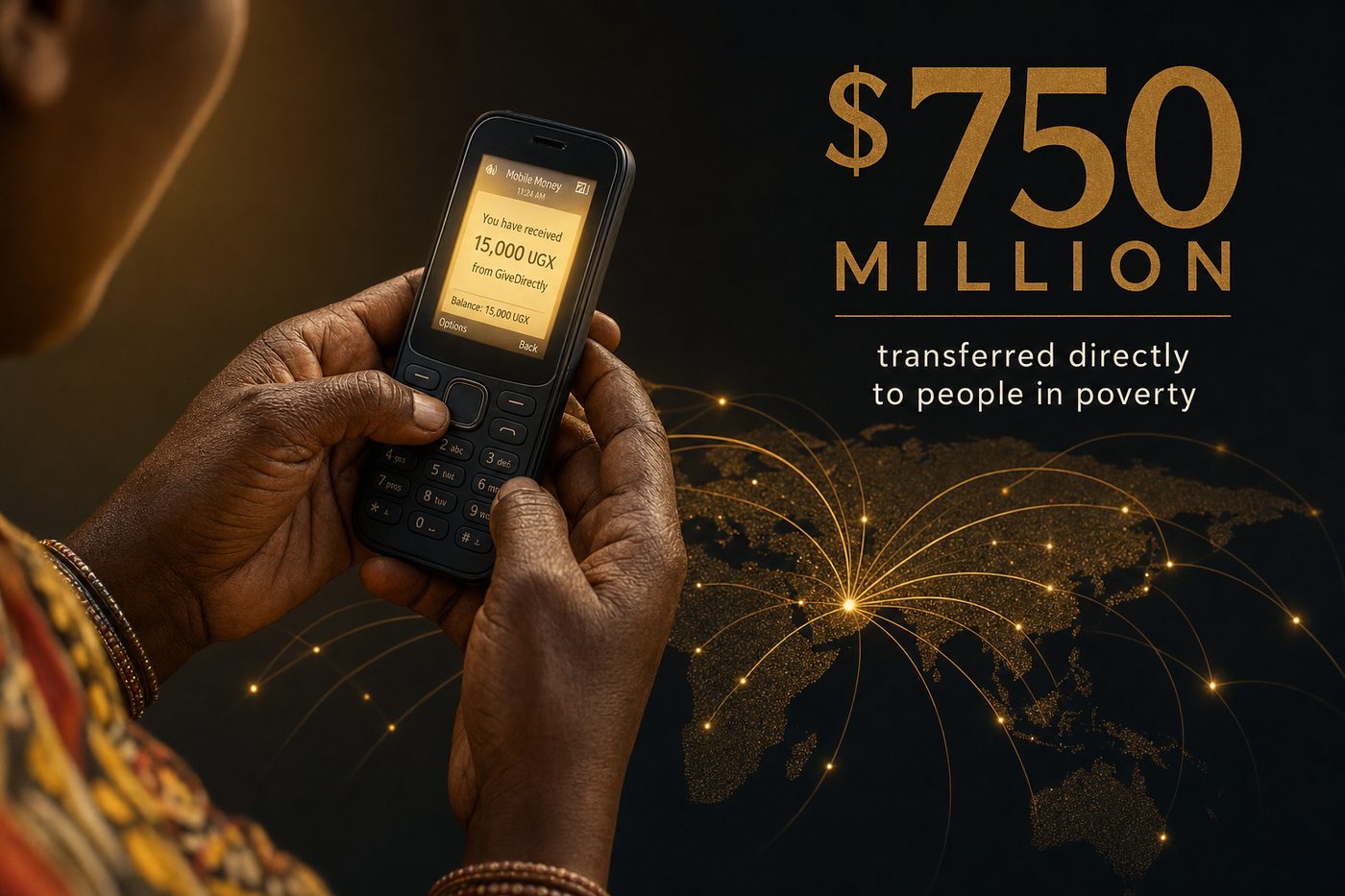
The idea is almost embarrassingly simple. Find people living in extreme poverty. Send them money. No strings, no programmes, no conditions, no monitoring of how they spend it. Just cash.
GiveDirectly has been doing this since 2008. They've now delivered over $1 billion to more than two million people across multiple countries on three continents (GiveDirectly, 2026). They are one of GiveWell's top-rated charities, and arguably the most important innovation in aid delivery in the past two decades. Not because cash transfers are new (governments have run conditional cash transfer programmes since the 1990s), but because GiveDirectly removed the conditions and proved the model works at scale.
What the evidence says
The evidence base for unconditional cash transfers is now among the strongest in development economics. Three landmark studies anchor the field.
The Kenya study. Haushofer and Shapiro (2016, Quarterly Journal of Economics, with later follow-ups) studied households in rural Kenya that received one-time transfers of roughly $1,000, comparing 503 treatment households against a control group. Around nine months after the transfers, recipient households showed: a 61% increase in the value of durable assets, a 33% increase in monthly earnings, roughly a 10% improvement on a food security index, and measurable gains in psychological wellbeing (a 0.16 to 0.26 standard deviation improvement). Later follow-up work found most economic gains persisted, with some attenuation but no reversal.
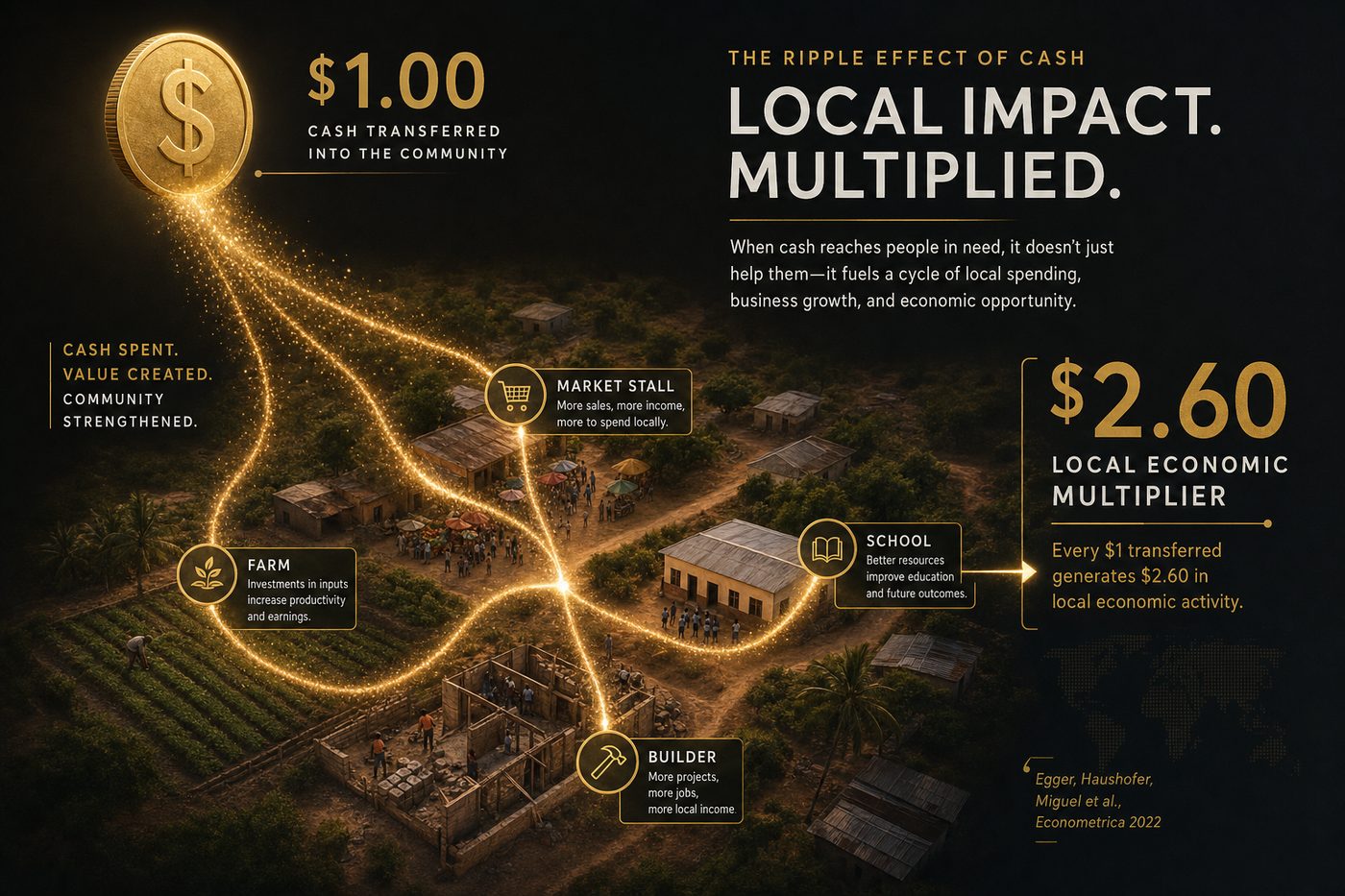
The village-level saturation study. Egger, Haushofer, Miguel et al. (2022, Econometrica) measured what happens when an entire area receives cash, distributing roughly $1,000 transfers to over 10,500 households across 653 villages. The finding: a local transfer multiplier of 2.4. Every dollar transferred generated about $2.40 in local economic activity because recipients spent money at local businesses, who hired more, who spent more, with minimal price inflation. This multiplier effect is the strongest argument against the "dependency" critique.
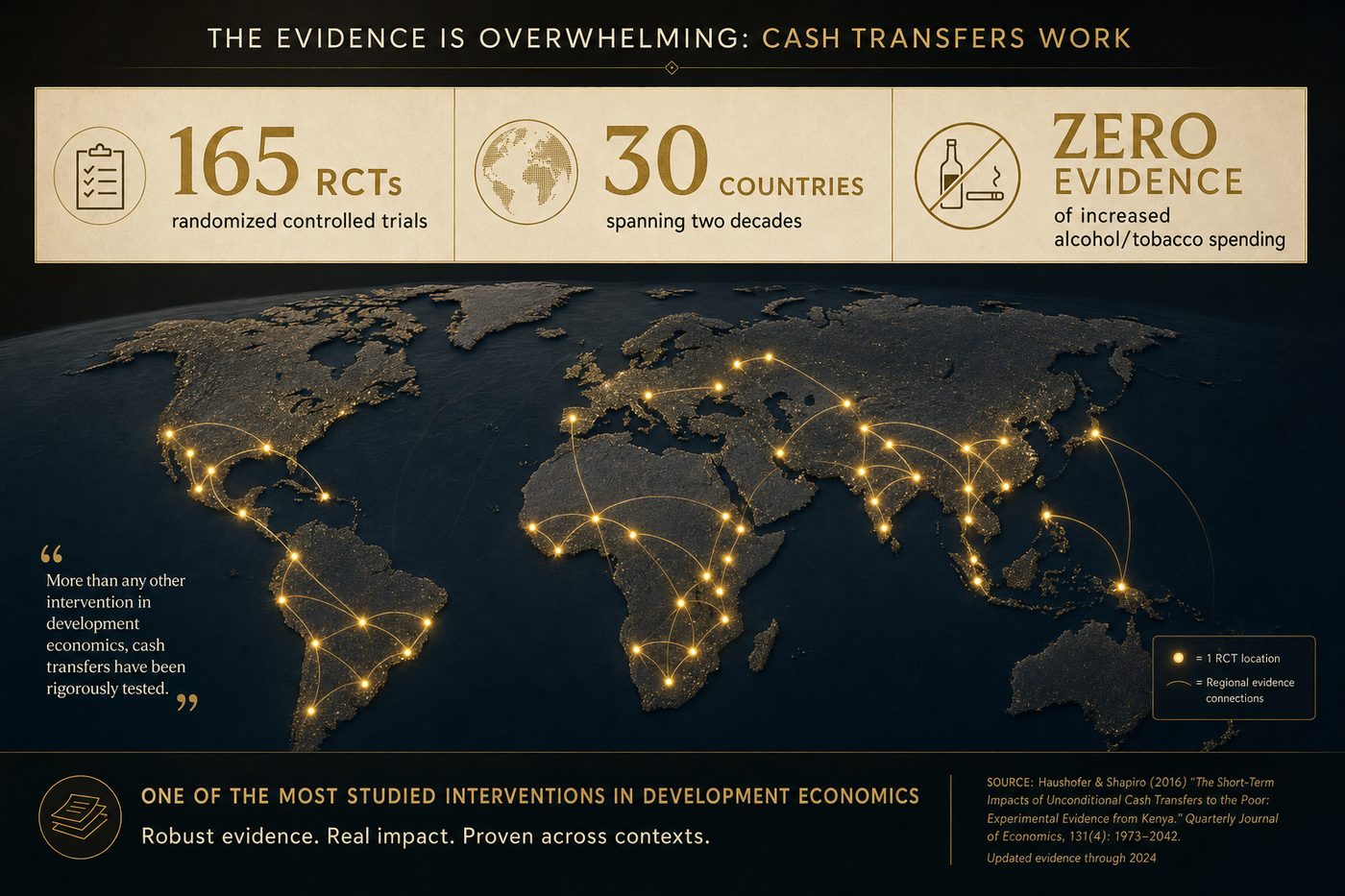
The large-scale evidence review. The Bastagli et al. review (ODI, 2016) synthesised 165 studies covering 56 cash transfer programmes across 30 low- and middle-income countries. The meta-finding: cash transfers consistently improve consumption, assets, food security, and other outcomes in the direction policymakers intend. There is no consistent evidence that they increase spending on alcohol or tobacco (a persistent myth the data does not support), and for most studies cash transfers had no negative effect on employment.
Why cash is philosophically interesting
Cash transfers are the closest thing in aid to a universal benchmark. GiveWell uses GiveDirectly as their comparison point: when evaluating any charity, the question is "does this programme do more good per dollar than just giving the dollar to a poor person?"
That framing is radical. Most of the aid industry is built on the premise that experts know better than recipients how to spend money. Conditional cash transfer programmes (like Mexico's Progresa/Oportunidades, now Prospera) attach requirements: children must attend school, mothers must visit health clinics. The conditions assume that recipients won't make good choices without external incentives.
GiveDirectly's data challenges that assumption directly. Unconditional recipients make broadly similar choices to conditional recipients. The conditions add administrative cost (roughly 5-15% of programme budgets go to compliance monitoring) without substantially changing outcomes. The strongest version of this argument comes from Baird, McIntosh and Ozler (2019): conditional and unconditional transfers produce "statistically indistinguishable" effects on most outcomes when transfer sizes are equivalent.
The cost structure
Do Gooder
One good decision a week
The research behind each piece takes hours. Get the next evidence-backed read every Tuesday, in 3 minutes.
Free weekly read. Unsubscribe anytime, no guilt.
GiveDirectly's operating model is unusually transparent. Their 2024 annual report breaks down costs as follows.
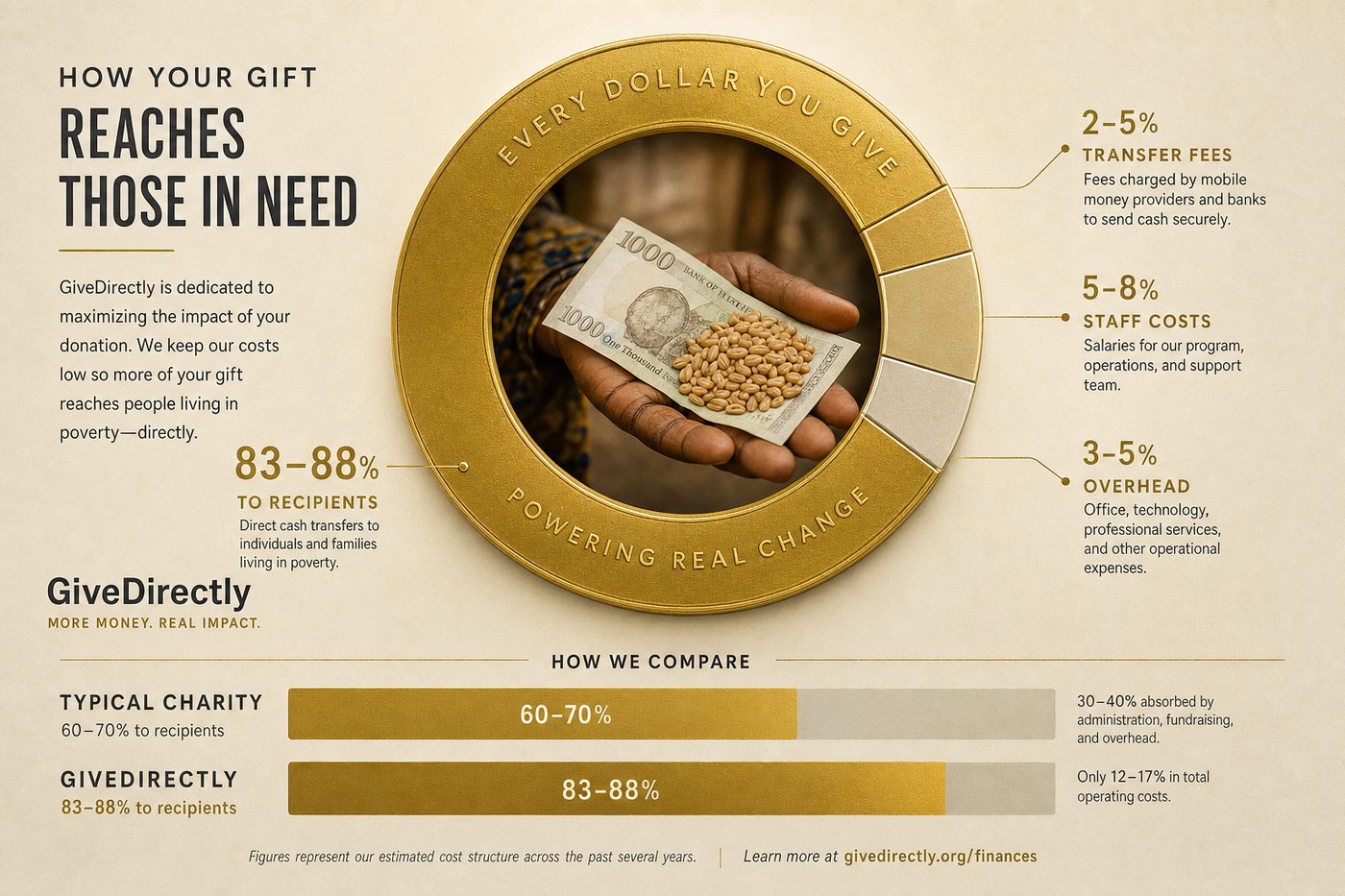
Transfer efficiency: GiveDirectly reports that around 85 cents of every dollar given to its poverty relief programmes reaches recipients as cash (roughly 84.8% as of their latest figures). The remainder covers mobile money transfer fees, staff costs for enrolment and targeting, and overhead. This is high by charity standards.
Cost per recipient: roughly $1-3 to deliver $1,000 in transfers, depending on the country and delivery method. Mobile money (M-Pesa in East Africa, similar platforms elsewhere) has dramatically reduced transfer costs compared to earlier cash distribution methods.
Scale efficiency: costs per dollar transferred have declined roughly 30% since 2018 as GiveDirectly has scaled, mostly through better mobile money infrastructure and more efficient targeting.
What cash can't do
Honest assessment of limitations.
Cash doesn't build institutions. A hospital, a school curriculum, a legal framework for property rights: these require sustained institutional investment that individual transfers don't provide. Cash improves individual welfare within existing systems. It doesn't change the systems.
Cash is less cost-effective than the best health interventions. GiveWell's 2024 cost-effectiveness analysis estimates that their top health charities (Against Malaria Foundation, Malaria Consortium, Helen Keller International) are 5-10x more cost-effective than GiveDirectly per dollar in terms of lives saved. If your goal is strictly to maximise health outcomes per dollar, targeted health interventions beat cash.
Cash doesn't address collective action problems. Climate change, pandemic preparedness, institutional corruption: these require coordinated responses that individual transfers don't address. Cash is a powerful tool for individual poverty alleviation. It's not a tool for systemic change.
Why it still matters
Three reasons GiveDirectly is a bright spot worth studying.
It raised the bar. Before GiveDirectly, most charity evaluation compared programmes against doing nothing. Now the relevant comparison is: does this programme outperform just giving cash? That reframing has improved the rigour of the entire sector.
It respects autonomy. The philosophical case for unconditional cash is fundamentally about dignity. Recipients decide their own priorities. A farmer who needs a tin roof doesn't need an NGO to tell them that. This matters beyond efficiency metrics.
It proves scale is possible. Over $1 billion delivered, across multiple countries, with consistent results. The "that's nice but it doesn't scale" objection has been tested and answered. The remaining question is political will, not operational feasibility.
For your giving
If you're choosing where to donate and want high confidence that your money will reach someone in extreme poverty and meaningfully improve their life, GiveDirectly is about as close to a sure thing as exists in charitable giving. It won't maximise impact per dollar (GiveWell's top health picks likely do that), but it will reliably, measurably help someone.
The minimum donation is $0 (no minimum). Monthly recurring gifts are available. Donations are tax-deductible in the US, UK (via a partner), and several other countries.
One sentence
GiveDirectly proved that giving money directly to people in extreme poverty works, at scale, with rigorous evidence, and raised the bar for every other charity in the process.
Sources
- GiveDirectly: Send money to people living in poverty (accessed June 2026)
- Financials | GiveDirectly (accessed June 2026)
- Research study: Months after payments end, households earn more, own more, eat more & are happier (GiveDirectly, on Haushofer and Shapiro) (accessed June 2026)
- General Equilibrium Effects of Cash Transfers: Experimental Evidence from Kenya (Egger, Haushofer, Miguel et al., NBER w26600) (accessed June 2026)
- Cash transfers: what does the evidence say? (Bastagli et al., ODI 2016) (accessed June 2026)
- GiveDirectly's Cash for Poverty Relief Program | GiveWell (accessed June 2026)
More in Bright Spots