The case for boring, recurring giving
19 April 2026 · 5 min read
Ask a charity fundraiser which kind of donor they'd trade for the other, and they will almost always pick the monthly giver over the one-off.
This is not nostalgia. It's maths, and a reasonably well-studied corner of behavioural economics.
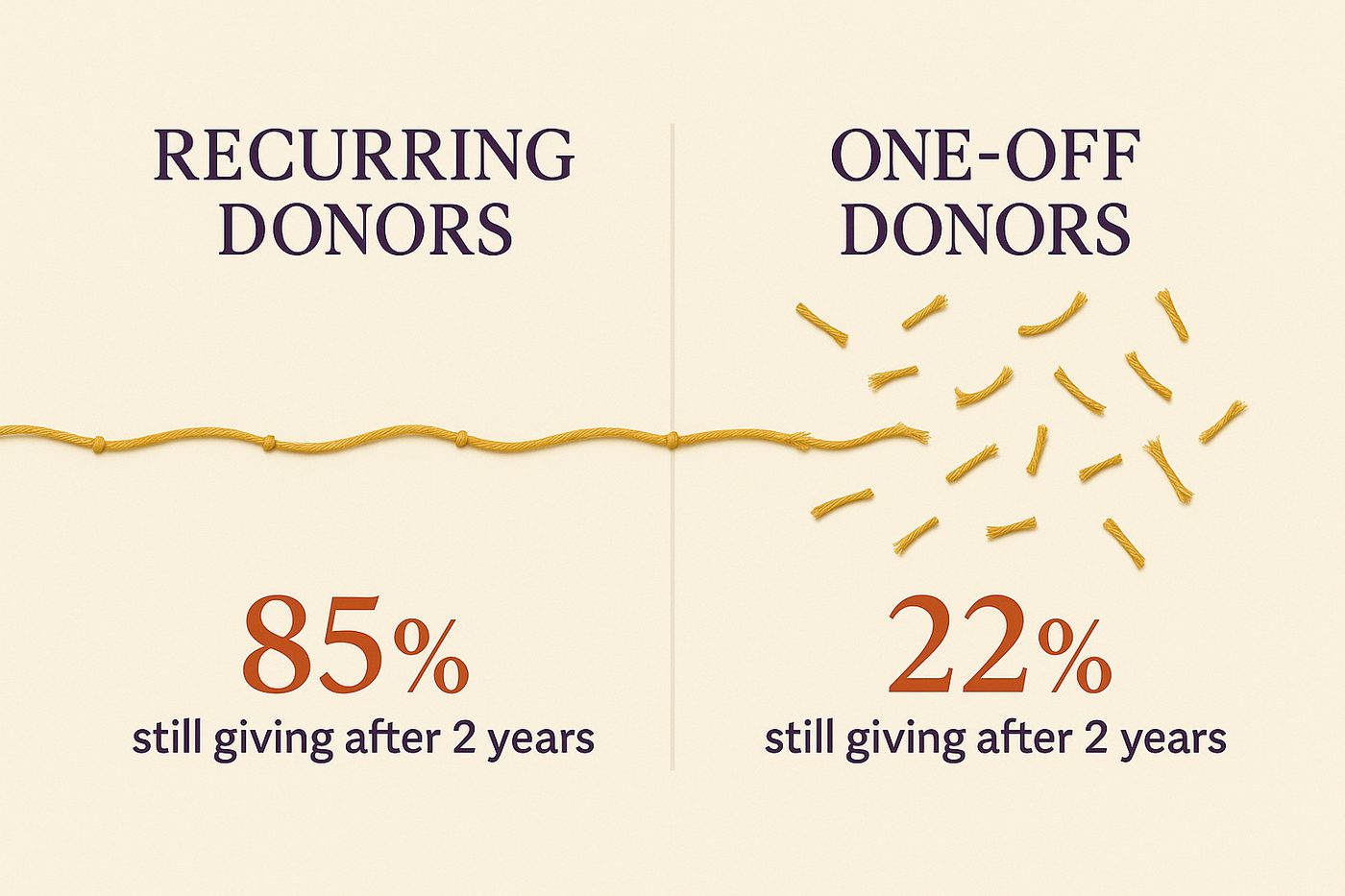
A 2023 Charity Navigator review of monthly-giving data across its rated charities puts two-year retention of recurring donors at roughly 85%, versus roughly 22% for one-off donors over the same period. The average monthly gift (around 25 dollars) is smaller than the average one-off gift (closer to 128 dollars), but the lifetime value of a recurring donor is five to eight times higher across most studies.
The gap isn't because recurring donors are richer. It's because automation beats intention.
The intention gap
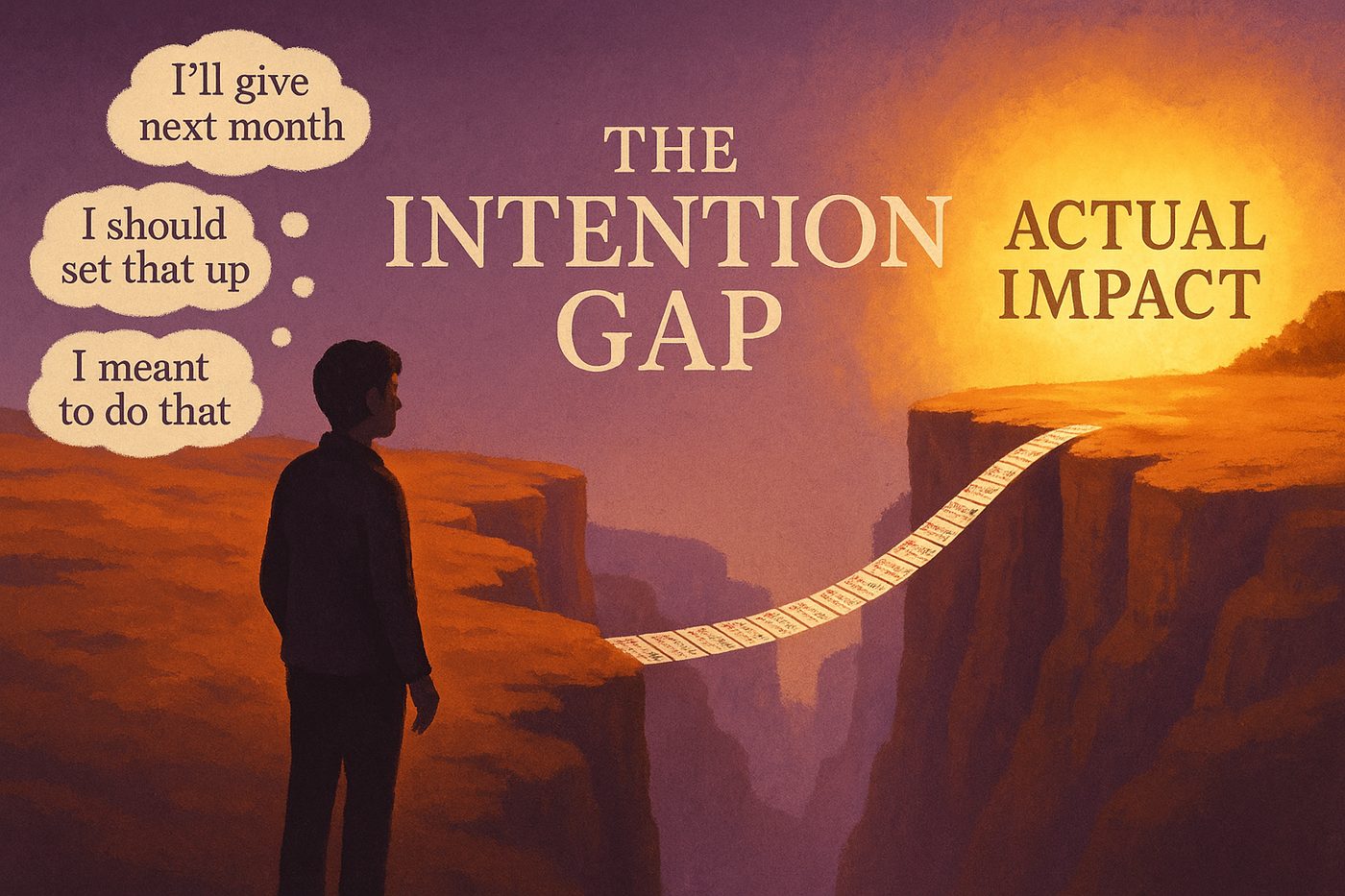
Behavioural economists call the space between "I intend to do X" and "I did X" the intention-action gap. It's been studied across voting, retirement saving, exercise, and giving. The pattern is consistent. People who say they'll do a good thing this year do it roughly 30-50% of the time if it requires an active decision, and 85-95% of the time if it's pre-committed and automatic.
Direct-debit pension contributions are the classic case. The Thaler and Benartzi Save More Tomorrow paper (2004) showed that workers who enrolled in auto-escalating pension schemes saved substantially more over a decade than workers who said they'd save more, didn't, and felt bad about it.
Giving works the same way. The monthly standing order removes you from the decision. Every month, the choice is not "should I give?" but "should I cancel?" The default has been flipped in favour of the behaviour you said you wanted.
Why it compounds
There's a second, less-discussed reason recurring giving outperforms episodic giving.
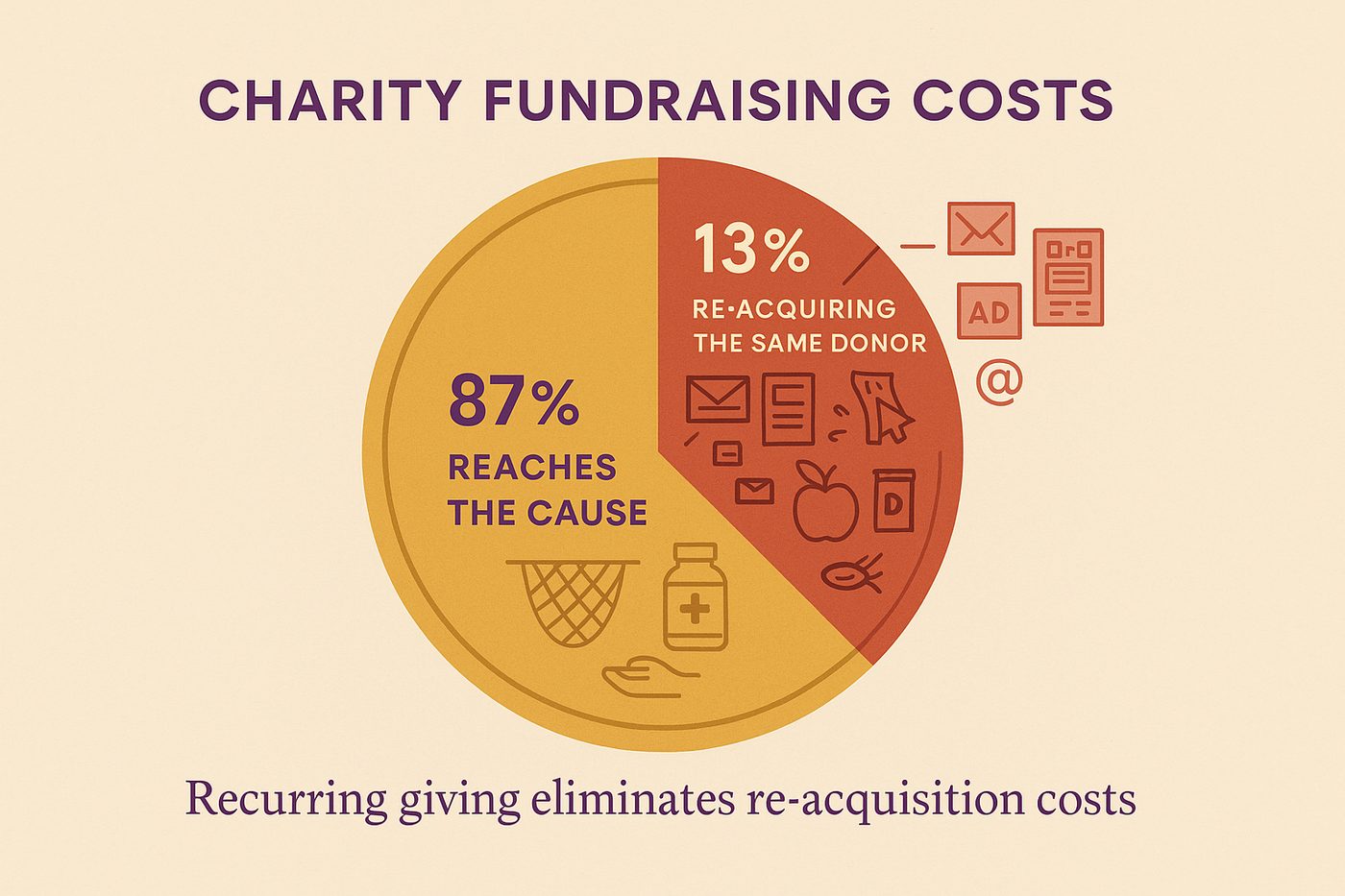
Charities that rely on episodic giving (big campaigns, end-of-year appeals, disaster pushes) have to spend heavily on acquisition every year. The UK Fundraising Regulator's 2022 sector report estimates that UK charities spent roughly 1.4 billion pounds on fundraising in a year where they raised 10.7 billion pounds from individual donors, so acquisition costs swallow roughly 13% of gross before anything gets deployed.
Recurring giving changes this. Once a donor is set up, the organisation's cost of holding that relationship is roughly an email, a thank-you, and occasional impact reports. That's close to zero marginal cost. The GiveDirectly 2023 annual report notes that recurring supporters account for a disproportionate share of the money that actually reaches recipients, because less of it is burned in acquisition.
For a cost-conscious donor, setting up a monthly gift is the most impact-efficient version of the same cash. You are bypassing the layer that eats 13% of the average charity's take.
The common objection
Do Gooder
One good decision a week
The research behind each piece takes hours. Get the next evidence-backed read every Tuesday, in 3 minutes.
Free weekly read. Unsubscribe anytime, no guilt.
Most people who push back on this make roughly the same argument. "I don't want to lock myself in. What if I want to give somewhere else next year?"
That objection treats a monthly standing order as a marriage. It's not. You can cancel a monthly gift in about forty seconds. Most charities make it deliberately easy because they know fighting it damages the brand.
The more interesting version of the objection is about optionality cost. If you give 25 pounds a month to Charity A, you've "used" that money, even though in a different month you might have given it to Charity B, which might have been marginally better on that day.
This is real. It's also mostly solved by picking a shortlist of good charities, not a single one. Set up three or four monthly gifts across organisations you believe in. The total adds up to roughly the same as the one-off you'd have given anyway. The variance across "which of these gets my November cash" is much smaller than the variance between "I gave this year" and "I meant to give this year and didn't."
The playbook
Three practical steps that usually work.
One: set it up in the next twenty minutes. Not Tuesday. Not this weekend. Open the banking app, pick one charity you've been meaning to give to, set a small monthly amount. 10 pounds, 25 pounds, whatever is comfortable. The amount is less important than the automation.
Two: pick the amount that feels genuinely frictionless. Not the amount that feels heroic. Heroic amounts get cancelled when money gets tight. Frictionless amounts survive a decade. Singer's progressive pledge, Giving What We Can's sliding scale, the Mormon 10%, all of these work because they're calibrated to not be the thing you cancel first when the car breaks.
Three: review once a year, not once a month. The monthly version is a behavioural hack. Don't pick it apart every thirty days. Once a year, look at what you gave, whether you'd do the same again, and whether the number should go up. That annual review is where intention should re-enter. The rest of the year, let the standing order do its job.
The slightly annoying truth
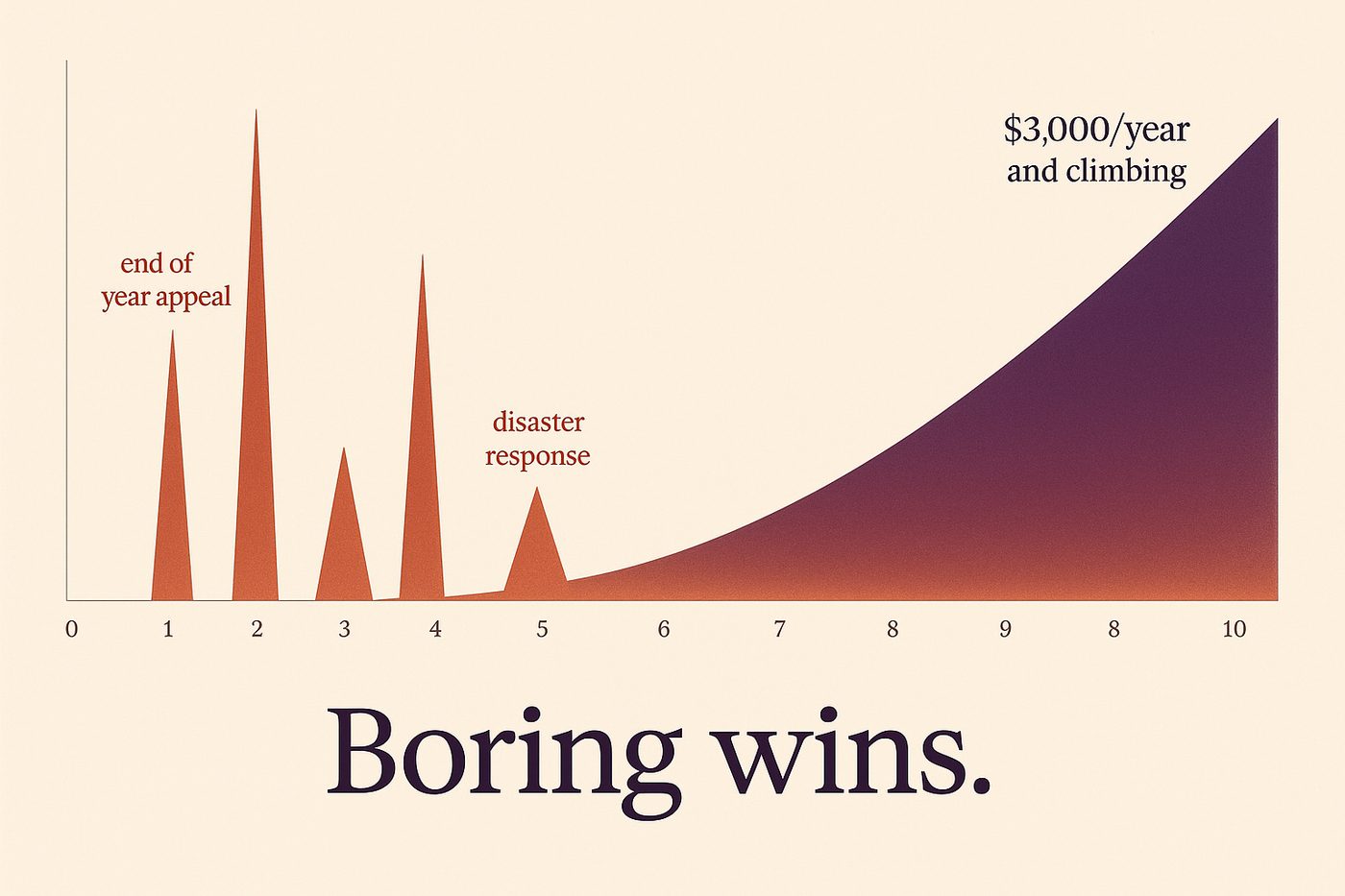
Recurring giving is not exciting. It's not the big gesture, the disaster-response moment, the photo with the cheque. For that reason a lot of donors systematically under-use it, and charities know this, and spend an inordinate amount of fundraising budget re-acquiring the same donors every year.
It is also, by most measurable metrics, the single most leveraged move an individual can make in the "how do I give well" space. Pick the thing, automate it, walk away, review once a year. Most of the work gets done by you not having to do the work.
Sources used: Charity Navigator Monthly Giving Report (2023), Thaler & Benartzi, Save More Tomorrow, Journal of Political Economy (2004), UK Fundraising Regulator Annual Report (2022), GiveDirectly Annual Report (2023), Nonprofit Tech for Good Report (2023), Giving What We Can Pledge data (2023). Full links in the planning doc.
More in The Life Edit